Showing posts with label integrity. Show all posts

Monday, February 9, 2015

Tattoos and Plagiarism


Don't sue me, Uncle Walt!
Plagiarism is an ongoing concern in the tattoo industry, rearing its ugly head in three forms.  The first is direct tattoo plagiarism; when an unscrupulous "tattooer" pulls photos from the Internet or other sources and claims the tattoos displayed are their work.  I have seen this kind of thing go even further with wanna-be tattooers stealing entire portfolios out of shops.  Usually, there are some tell-tale indications of this. Whenever someone would come to the shop I worked at and displayed a portfolio with numerous divergent styles and inconsistency in quality of work, a simply image-search on Google usually revealed the scam.  The reason for this act is simple; a "tattooer" who has not been professionally trained through an apprenticeship has come to the conclusion that the only way to grow (or to make real money) is to be in a tattoo studio.  Should they bother to try to get in with their own woefully inadequate portfolio, they quickly recognize that if they can get away with taking credit for another person's work, they can get their foot in the door.  Internet savvy studios catch this scam quickly, and if not it becomes obvious during the audition tattoo that is a common practice in most shops.

 The second form of plagiarism is when a tattooer copies a tattoo done by another artist. This is actually quite common.  Customers who are themselves budding tattoo aficionados find an image in a tattoo magazine or on a website that they just have to have, and they bring it into their local tattooer to get it themselves.  I say "budding" aficionados because collectors soon learn the value of having original work custom designed for them by a tattooer they admire and trust.  Tattooers will often offer to put their own spin on the design, but if the customer is adamant about getting that tattoo, then typically that is the tattoo they get.

 As an aside, a favorite joke a friend of mine tells is about they guy who walks into a tattoo convention on the last day and asks who won the "most original" tattoo contest.  He then turns to an artist who is looking for a customer and says, "I want that one."

You can only do praying hands so many ways.
 The problem here is that it can be difficult to discern a custom tattoo from a tattoo that was originally a tattoo flash design (based on a design that was created and marketed to tattoo studios and tattooers with the intent that it would be offered to customers en mass).  There are also degrees of this kind of copying; from biting off (hard) on another artists style, to blatantly copying line-for-line another tattoo.  The simple truth is that newer tattooers who have little to put into their portfolios will often include pieces that started as flash or are copies of tattoos from another artist. Older tattooers will often fill their portfolios with custom work and designs of their own.  It is a part of the maturation process in the life of a tattooer. We learn by trying other people's styles until we eventually develop our own.  Even in styles with strict parameters like American Traditional; the best artists eventually find a way to step out from under the shadows of those before them and do their own thing, but only after a healthy number of years imitating the artists they admire.

 The third type of plagiarism is related to the second, but deals with art that is not a tattoo, and obviously not tattoo flash.  The scenario presented by Deb Yarian in her own article: Flattery, Thievery, or Just Plain Business (to which this article is a response, thanks Deb!) is thus:

 A client walks into your studio with a piece of art they wish to have tattooed.  The tattooer, concerned about simply copying another artist, suggests they could create something similar, but the client balks and insists, aside from making the design more tattoo-friendly, they want it unchanged.  Does the tattooer do the design, and if so what obligations do they have, ethically and legally, to inform the original artist?

 Let us consider the legal issue first.  Plagiarism, the wrongful appropriation or copying of another person's works, generally refers to writing, but also covers other forms of art and intellectual property.  Plagiarism is itself not a crime.  Copyright Infringement is a crime, though how that crime is defined and enforced is a slippery issue.

 A copy is defined in US Copyright Laws as a direct reproduction.  The law further covers the unauthorized distribution of copies.  Interestingly, it is not considered copying to translate a design from one medium to another; ie from a 2-D drawing to a 3-D sculpture. Describing a painting in extreme written detail is not a violation of copyright.  A piece of art which is translated into a tattoo by a tattooer fits into this idea.  

 If a holder of an intellectual copyright wishes to protect their work from being translated into other media, they must trademark the works, which offers further protection.  Courts have, however, found in favor of copyright holders who's work had been translated into other mediums and mass-marketed, ie dolls being produced without authorization from cartoons.

Not a gill-man, it's a cabbage monster. Yeah...
 Tattoos may also fall under the Fair Use Doctrine in a loose manner.  A tattoo is not designed to supersede the original.  It will not replace or compete with the original work in the market.  Tattooing a design also does not impact the value of the original work.  Where there may be an issue is that the nature of the copied work is typically not of a private work which should be public domain, the translation of the work is for profit (not the betterment of the public), and the copy is often substantially similar to the original (even if translated into a new medium). 

 So, if an artist wished to pursue legal action against the creation of a tattoo using their work, they potentially have grounds to do so.  The tattooer can limit the likelihood of this by not offering the design to the public, and by not including the finished tattoo in their portfolio or in their advertising.  This makes the recreation a one-time job, and not further exploitation of another's work for profit.

 In reality, we see this kind of thing all the time.  In fact, tattoo flash often includes images which are clearly the copyright of another party, such as sheets featuring famous movie monsters, actresses, or cartoon icons.  Either this kind of homage is considered beneath the holders of the copyright to be overly concerned with, or the potential reward for pursuing legal recourse is too trivial to consider.  

 Keep in mind though that legally, you never know what will trip a big corporation's trigger. A story I have heard, which may be little more than an urban legend, deals with amateur auto-racing.  Before NASCAR, racers would mark their cars with numbers and distinctive designs, including cartoon characters from Disney and Warner Brothers cartoons.  This was until Disney began threatening to sue the violators of their copyright, resulting in Ed Roth's "Rat Fink" design.  Disney again sought legal recourse in the 1970's against the creators of "Air Pirates", an underground comic book which saw only two issues ever published.  

 Legally, odds are you are fairly safe as a tattooer using another artist's design, especially if your do not try to make a name for yourself as the originator of the work.  Ethically, things get even more fuzzy.  Ethics are almost exclusively a matter of one's personal philosophy.  I mentioned above that the use of major commercial designs is fairly common place.  There are artistic "parodies" of various designs and likenesses which skirt the line between homage and copy.  It doesn't make it right, but published artists have their work copied into tattoos so frequently that some even consider it a tribute and feature the tattoos in publications with their work. 

Make it your own.
 Where I think that there is an ethical need to inform the artist is when said artist would have benefited significantly from the paid-use of their work.  $25 will not mean much to a person who's work is featured in Playboy or Hi-Fructose (it is not my intent to liken one publication to another, they just have both featured artists I enjoy), but may mean something to someone who is paying bottom dollar for a simple website displaying their art. The good-guy thing to do is share the tattoo image with them, so that they can use it to promote their own efforts.  The great thing to do is to send that artist a gratuity for the use of their work from your tattoo-profits.

 That said, until you are so well-off and renowned as a tattooer that you can insist on tattooing exclusively your designs in your style, you should probably do the tattoo.  The person making the request will just take it down the street to a tattooer with less scruples (and probably less skill) than you if you don't, plus will leave with a bad impression of your studio.   Do what you can to convince your client to allow you to do your own thing with it, but ultimately you need to give the client what they want. If you are really torn about it, ask your studio-owner what they think.  If it has been a slow week, they will probably favor profit over artistic integrity.

 Besides, having that Tasmanian Devil tattoo tucked deep in one of your old portfolios is kind of a right-of-passage as a tattooer.

  Jason Sorrell is a writer, tattoo artist, satirist, artist, and generally nice guy living in Austin, TX.  He loves answering questions about tattoos.  Shoot him a message at https://www.facebook.com/tattoonerdz/

.

Tuesday, December 2, 2014

What to Do When Someone Wants a Bad Tattoo

 This question was posed in a forum I follow:

 "We've all had clients walk in with a poorly rendered design that their sister/cousin/whoever has drawn for them that you know will end-up on a tattoo-fail-blog.  A design or concept you would not want your name attached to.  I take pride in my work and have gotten in trouble for refusing to do a tattoo someone requested, but it is my career and not the shop-owner's.  How do you handle it?"

 It happens.  Someone walks in with an ill-conceived design or concept.  It could be as simple as something that might be a wonderful piece of art but does not translate well into a tattoo.  Or, it could be something that is badly drawn that the client insists they want as is.  How should this be handled?

A questionable potential client...


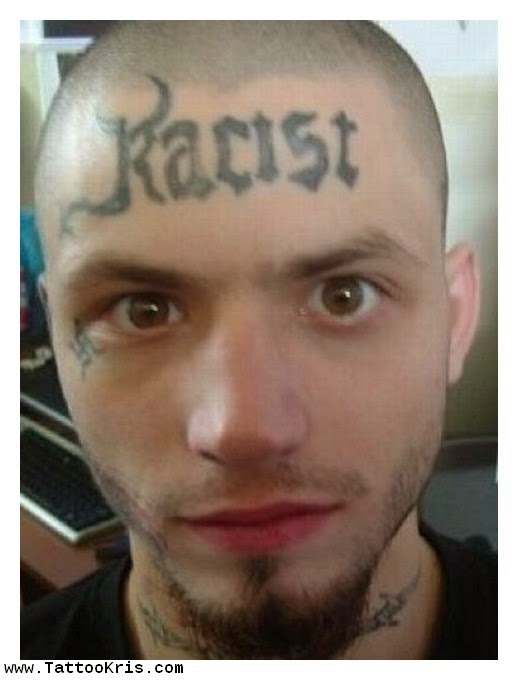
 There are limits to what you should or should not tattoo.  Most shops I have worked at, for example, refused to do tattoos that could be construed as gang-related, racist, or derogatory to sensitive segments of our society.  This is for two reasons.  First, the shop's reputation is on the line.  When you do that kind of tattoo, you become known for doing that kind of tattoo.  Others may come requesting that kind of tattoo, but you may put-off a larger clientele base that would consider being associated with that kind of work distasteful.  It is not worth the trouble.  Second, you are doing that client a favor.  One day, they may realize that the tattoo they thought they wanted to be "in" with the group they where trying to impress has hampered them socially and in finding employment.  Your saying "no" may be saving them years of regret in the future.

 These are solid limits that you should stick by.  Everything else comes down to artistic integrity, which can mean many things.  On the one hand, you as a tattoo artist want to have a body of work that suggests excellence and skill.  A poorly conceived design that the client insists on will not help your cause there.  

Funny until your grand-kids get a roll of quarters.

 However, on the other hand is your integrity as a tattoo artist to serve the client.  It is his or her tattoo, not yours.  Your function is to give the client what they want to the best of your ability.  Refusing to do certain tattoos can harm your reputation; you can be perceived as being "stuck-up" or thinking that you are too good to give someone what they want.  While you may be right about a design being bad, the hurt feelings caused by not doing the tattoo can be more damaging to your reputation than doing a bad tattoo.

 If a client comes in with a design that they commissioned or drew themselves, that design has an inherent emotional value to them.  If you look at the design and see a hot-mess, it is your job to educate the client as to their options.  First, be gentle and kind about the design.  Praise the work of the artist.  Ask how much experience that artist has.  Often, it may only be a few years, which can work to your advantage when you try to convince the client to go another way.  Find something you can say is positive about the design, and talk to the client about why they want it.  That design may be something that someone who has passed away has drawn or has some other sentimental value attached to it.  If that is the case, you do not want to change it, or change it much.  The client is not concerned about the quality of the design, only its sentimental value.

 If it is just a design that the client likes, they can usually be persuaded to let you change it.  This is the time to educate the client on the differences between art and tattoo art.  Explain the limits of the medium, why the design may not work well in the skin, or issues with the design itself you are concerned about (proportion, flow, etc).  Suggest allowing you to re-draw the design to make it more like a tattoo.

I really hope this was drawn by the client.

 If the client insists that they want the design as-is, you can try to price yourself out of the tattoo, although this is not always a good idea.  Show the client your portfolio and discuss your style and your strengths.  This may get the client thinking the design could be better.  If after seeing your portfolio the client still wants the design as-is, offer a price 25-50% above what you would normally charge.  If they ask why it is so expensive, explain the effort that will be required to render that design as accurately as possible and overcoming the limits you described about tattooing.  

 Also, have a client sign an "informed consent" waiver, a document that states that you, as the tattooer, have explained that the design selected is ill-advised, and you have discussed with them the limits of the tattoo process and potential issues they may face.  While it won't save your reputation if the client a year from now tries to blame you for a bad design to their friends (why did he let me get this tattoo?), it will give them another moment to re-think what they are doing.

 When you tattoo a design that you do not like, a huge mistake is made if you do not give it the same effort and attention that you would a design you do like.  A design you do not like should be given more effort, to make it as good as possible.  Every line should be clean and every color solid; cut no corners.  Even if the design is bad, the tattoo itself should be excellent.

 Finally, take a photo of the design and the tattoo side-by-side.  This can work to your advantage in your portfolio.  The design may be bad, but future clients can see just how precise and accurate your were in it's rendering, and they can see that the client elected to get that design, as it is distinct from the other tattoos in style and format in your portfolio.

 It is tempting for a tattooer to limit themselves to tattoos that they like or are in a style they appreciate.  It is good to know your limits; one who is not experienced in doing portraits should probably explain to a client who wants a portrait that it is not your thing.  That is being responsible.  Sticking to your style in other matters, however, should not be a major concern until the demand for your style is so great that you are turning down tattoos due to being booked months in advance.  

 Keep in mind also that it is not just your reputation on the line, but your shops as well.  The shop has a stake in every client that walks through their doors beyond their percentage.  The advertising dollars spent brought that client into the shop, which means every client that comes in is an opportunity to recoup that cost that should not be wasted. A client who does not get what they want from a shop will not talk about the snooty artist, but the snobby shop that refused to give them their tattoo.  The shop they go to that does do the tattoo will only encourage this way of thinking in their minds.

Actually tried to sue her artist over this choice.

 Finally, it may not be the design that is objectionable, but the placement.  The hand or facial tattoo will impact that client for the rest of their life.  That silly tattoo across their ass may seem cute now, but not so cute in twenty years.  Advise the client as best you can about the potential risks, and if they insist, video-tape the process and use it for advertising.  

 The bottom line is that tattooing is a service-industry.  We give our clients what they want to the best of our ability.  Do your best to give them a great tattoo, and if they insist on a poor design at least they will get it fully aware of your concerns and in a manner that is as technically sound as possible.


 Jason Sorrell is a writer, tattoo artist, satirist, artist, and generally nice guy living in Austin, TX.  He loves answering questions about tattoos.  Shoot him a message at https://www.facebook.com/tattoonerdz/