Sunday, March 1, 2015

Getting a Tattoo From Someone Other Than Your Regular Artist

 You have a tattooer that you really like.  He or she does amazing work, you have a good relationship, you get a fair price for your tattoos, and you have gotten a few tattoos from this one artist.  You feel like this person is "your tattooer", the person you go to for your tattoos and advice on tattoos.  Your tattooer is strongest, however, with one particular style of tattoos, and you want a tattoo in a style that you think will be outside their skill-set.  In other words, you have another tattoo artist in mind, but you don't want to damage the relationship you have with your current tattooer. What do you do?

 If this scenario sounds a little odd to you, it is because with most professionals this would not be an issue.  An Italian Chef is not going to hold it against his clients if one night they decide to go to an American Restaurant because they were in the mood for some American Food.  Unfortunately, tattooers are often a bit superstitious about the industry, maybe even a little paranoid.  We often find ourselves with the mentality that every tattoo done by another tattooer is an opportunity lost, and money out of our own pockets.  When one of our clients goes to another artist, we tattooers worry that the shop will be better, that the other artist will offer a negative opinion of our work or try to undercut our pricing, or will frankly just provide a better experience for the client. 

 The reality is that all of these concerns are valid, at least to a point.  We tattooers tend not to see that those concerns are well with in our control.  Being tattooers ourselves, we should assume that our work will be critiqued and the other tattooer will try to win over our client. The question we should ask ourselves is what steps we took to prevent that tattooer from being successful?  If we are concerned about the quality of our shop, then we should have stepped-up and corrected any deficiency.  If we are afraid of a negative critique, then we need to be our own worst critics and truly strive to improve and do our best work on every tattoo.  If we think the other tattooer might provide a better experience, then we need to know and correct the ways which we miss the mark.  

 In short, if our client needs to go to another tattooer for one tattoo because it is simply outside our skill-set, we need to be confident that this is the ONLY reason they are going to another tattooer.

 From the onset of this idea, we have a problem.  If your client feels that they need to be concerned about offending you, then you have already done something wrong.  Your client should recognize that you are a professional, fully aware of your own strengths and weaknesses.  If you are a professional, then you should have no issue discussing with your client what their tattoo needs are, how you can address them, and if you are unable to meet their needs, how they should go about finding an artist who can.  Indeed, as a professional caring for your client, it may even behoove you to have an artist or two in mind you know will do the job, offer a fair price, and treat your client in the same manner you would.

 A doctor will recommend their patients to a specialist when necessary.  A mechanic will send work to another shop if their customer's car needs something they do not offer. If your client comes to you seeking advice about getting a tattoo from another artist, you should feel good that you have built a professional relationship with your client and they see you as a resource they can trust in the tattoo industry.  Taking care of your client, even if it means sending them down the street for a tattoo that is outside your skill-set, is better than losing them because you have a poor attitude, or worse because you gave them a tattoo that was not on par with your normal work when you couldn't bare to do the right thing and send their money to someone else.  

 As a client, you should know that despite our sometimes fragile artistic egos, we tattooers tend to be realists.  If your tattooer does primarily American Traditional work, and you want a portrait, you should be confident that your tattooer will steer you right.  We tell our clients to always, always, ALWAYS look at portfolios when shopping for an artist, and we hope that the reason you selected us was founded on the strength of our portfolios.  With this in mind, we also must know that if a style of tattoo that you want is not in our portfolio, you will have concerns about our ability to execute it. You should expect professionalism from your tattooer, and that they will be willing to talk to you about any aspect of the tattoo process, including potentially needing to go to another artist.

 If you consider someone your tattooer, simply be open and frank with them.  Tell them what you want and what your concerns are about their ability to do the tattoo,  Be prepared also to give them the opportunity to show you what they can do with your concept.

 What that means is being willing to pay your tattooer's drawing fee and being open to seeing their take on your idea.  Your tattooer is your tattooer for a reason; you like their style and their technique.  It may be that they can present your concept in a manner that you had not considered, translating it into their style.  This will have the added advantage of keeping your work consistent, as you will hopefully get many additional tattoos from that tattooer. Being ready to pay when you have this discussion also demonstrates that you are sincere about your appreciation of their work and that you really do want to keep them on as your tattooer.  Your tattooer may even be willing to apply that drawing fee as a down-payment on your next tattoo from them, depending on your relationship.

 You, as a client, should never be anxious about addressing concerns with your tattooer.  If you are, then you may have reason to be concerned.  Not every tattooer can do every tattoo, and a professional tattooer will want you to have good tattoo work, even if the work is not their own.  They would rather have you sing their praises for taking care of them than have a tattoo you regret getting and they regret doing.

 Jason Sorrell is a writer, tattoo artist, satirist, artist, and generally nice guy living in Austin, TX.  He loves answering questions about tattoos.  Shoot him a message at https://www.facebook.com/tattoonerdz/.

Monday, February 9, 2015

Tattoos and Plagiarism


Don't sue me, Uncle Walt!
Plagiarism is an ongoing concern in the tattoo industry, rearing its ugly head in three forms.  The first is direct tattoo plagiarism; when an unscrupulous "tattooer" pulls photos from the Internet or other sources and claims the tattoos displayed are their work.  I have seen this kind of thing go even further with wanna-be tattooers stealing entire portfolios out of shops.  Usually, there are some tell-tale indications of this. Whenever someone would come to the shop I worked at and displayed a portfolio with numerous divergent styles and inconsistency in quality of work, a simply image-search on Google usually revealed the scam.  The reason for this act is simple; a "tattooer" who has not been professionally trained through an apprenticeship has come to the conclusion that the only way to grow (or to make real money) is to be in a tattoo studio.  Should they bother to try to get in with their own woefully inadequate portfolio, they quickly recognize that if they can get away with taking credit for another person's work, they can get their foot in the door.  Internet savvy studios catch this scam quickly, and if not it becomes obvious during the audition tattoo that is a common practice in most shops.

 The second form of plagiarism is when a tattooer copies a tattoo done by another artist. This is actually quite common.  Customers who are themselves budding tattoo aficionados find an image in a tattoo magazine or on a website that they just have to have, and they bring it into their local tattooer to get it themselves.  I say "budding" aficionados because collectors soon learn the value of having original work custom designed for them by a tattooer they admire and trust.  Tattooers will often offer to put their own spin on the design, but if the customer is adamant about getting that tattoo, then typically that is the tattoo they get.

 As an aside, a favorite joke a friend of mine tells is about they guy who walks into a tattoo convention on the last day and asks who won the "most original" tattoo contest.  He then turns to an artist who is looking for a customer and says, "I want that one."

You can only do praying hands so many ways.
 The problem here is that it can be difficult to discern a custom tattoo from a tattoo that was originally a tattoo flash design (based on a design that was created and marketed to tattoo studios and tattooers with the intent that it would be offered to customers en mass).  There are also degrees of this kind of copying; from biting off (hard) on another artists style, to blatantly copying line-for-line another tattoo.  The simple truth is that newer tattooers who have little to put into their portfolios will often include pieces that started as flash or are copies of tattoos from another artist. Older tattooers will often fill their portfolios with custom work and designs of their own.  It is a part of the maturation process in the life of a tattooer. We learn by trying other people's styles until we eventually develop our own.  Even in styles with strict parameters like American Traditional; the best artists eventually find a way to step out from under the shadows of those before them and do their own thing, but only after a healthy number of years imitating the artists they admire.

 The third type of plagiarism is related to the second, but deals with art that is not a tattoo, and obviously not tattoo flash.  The scenario presented by Deb Yarian in her own article: Flattery, Thievery, or Just Plain Business (to which this article is a response, thanks Deb!) is thus:

 A client walks into your studio with a piece of art they wish to have tattooed.  The tattooer, concerned about simply copying another artist, suggests they could create something similar, but the client balks and insists, aside from making the design more tattoo-friendly, they want it unchanged.  Does the tattooer do the design, and if so what obligations do they have, ethically and legally, to inform the original artist?

 Let us consider the legal issue first.  Plagiarism, the wrongful appropriation or copying of another person's works, generally refers to writing, but also covers other forms of art and intellectual property.  Plagiarism is itself not a crime.  Copyright Infringement is a crime, though how that crime is defined and enforced is a slippery issue.

 A copy is defined in US Copyright Laws as a direct reproduction.  The law further covers the unauthorized distribution of copies.  Interestingly, it is not considered copying to translate a design from one medium to another; ie from a 2-D drawing to a 3-D sculpture. Describing a painting in extreme written detail is not a violation of copyright.  A piece of art which is translated into a tattoo by a tattooer fits into this idea.  

 If a holder of an intellectual copyright wishes to protect their work from being translated into other media, they must trademark the works, which offers further protection.  Courts have, however, found in favor of copyright holders who's work had been translated into other mediums and mass-marketed, ie dolls being produced without authorization from cartoons.

Not a gill-man, it's a cabbage monster. Yeah...
 Tattoos may also fall under the Fair Use Doctrine in a loose manner.  A tattoo is not designed to supersede the original.  It will not replace or compete with the original work in the market.  Tattooing a design also does not impact the value of the original work.  Where there may be an issue is that the nature of the copied work is typically not of a private work which should be public domain, the translation of the work is for profit (not the betterment of the public), and the copy is often substantially similar to the original (even if translated into a new medium). 

 So, if an artist wished to pursue legal action against the creation of a tattoo using their work, they potentially have grounds to do so.  The tattooer can limit the likelihood of this by not offering the design to the public, and by not including the finished tattoo in their portfolio or in their advertising.  This makes the recreation a one-time job, and not further exploitation of another's work for profit.

 In reality, we see this kind of thing all the time.  In fact, tattoo flash often includes images which are clearly the copyright of another party, such as sheets featuring famous movie monsters, actresses, or cartoon icons.  Either this kind of homage is considered beneath the holders of the copyright to be overly concerned with, or the potential reward for pursuing legal recourse is too trivial to consider.  

 Keep in mind though that legally, you never know what will trip a big corporation's trigger. A story I have heard, which may be little more than an urban legend, deals with amateur auto-racing.  Before NASCAR, racers would mark their cars with numbers and distinctive designs, including cartoon characters from Disney and Warner Brothers cartoons.  This was until Disney began threatening to sue the violators of their copyright, resulting in Ed Roth's "Rat Fink" design.  Disney again sought legal recourse in the 1970's against the creators of "Air Pirates", an underground comic book which saw only two issues ever published.  

 Legally, odds are you are fairly safe as a tattooer using another artist's design, especially if your do not try to make a name for yourself as the originator of the work.  Ethically, things get even more fuzzy.  Ethics are almost exclusively a matter of one's personal philosophy.  I mentioned above that the use of major commercial designs is fairly common place.  There are artistic "parodies" of various designs and likenesses which skirt the line between homage and copy.  It doesn't make it right, but published artists have their work copied into tattoos so frequently that some even consider it a tribute and feature the tattoos in publications with their work. 

Make it your own.
 Where I think that there is an ethical need to inform the artist is when said artist would have benefited significantly from the paid-use of their work.  $25 will not mean much to a person who's work is featured in Playboy or Hi-Fructose (it is not my intent to liken one publication to another, they just have both featured artists I enjoy), but may mean something to someone who is paying bottom dollar for a simple website displaying their art. The good-guy thing to do is share the tattoo image with them, so that they can use it to promote their own efforts.  The great thing to do is to send that artist a gratuity for the use of their work from your tattoo-profits.

 That said, until you are so well-off and renowned as a tattooer that you can insist on tattooing exclusively your designs in your style, you should probably do the tattoo.  The person making the request will just take it down the street to a tattooer with less scruples (and probably less skill) than you if you don't, plus will leave with a bad impression of your studio.   Do what you can to convince your client to allow you to do your own thing with it, but ultimately you need to give the client what they want. If you are really torn about it, ask your studio-owner what they think.  If it has been a slow week, they will probably favor profit over artistic integrity.

 Besides, having that Tasmanian Devil tattoo tucked deep in one of your old portfolios is kind of a right-of-passage as a tattooer.

  Jason Sorrell is a writer, tattoo artist, satirist, artist, and generally nice guy living in Austin, TX.  He loves answering questions about tattoos.  Shoot him a message at https://www.facebook.com/tattoonerdz/

.

Wednesday, January 28, 2015

Keep Your Appointment (and What to Do When They Don't)

 Tattoo Nerd,

 I have been in the business for about 8 years now, and I have this client that got work from me when I was just staring out.  I hear from her once every year or so.  She asks about a tattoo for herself or a friend, and sets an appointment.  We hash out some of the details before I notice that she is getting a little flakey about keeping in contact and confirming her appointment.  This last week, she settled on a day but not a time, told me two days prior that she would get back to me about the design, never confirmed, and did not respond to any of my messages the day of the tattoo.  It is frustrating, and I am thinking that I should just write her off and not deal with her anymore.  I feel bad, because she was one of my first clients, but I think I have hit my limit.

 What do you think?

 First of all, let me say that I just love that people are starting to refer to me as "Tattoo Nerd".  I consider it high praise that I am being recognized for my work.  

 I think we, as tattoo artists, have all had clients like the one you described,  In fact, probably multiple clients.  I am not certain if the problem is a matter of casual disrespect or an exaggerated view of tattoo artists.  On the one hand, it could be that people do not consider being a tattoo artist a "real" profession.  They have no real concept of the time, dedication, and effort that goes into being a tattooer, often because they have not experienced that kind of effort in their own pursuits.  They may also fail to recognize the expense of setting-up for a tattoo or drawing a design in advance, because, hey, that is what we do for fun, right? 

 On the other hand, they may realize we are professionals and have a high degree of respect for what we do.  In their minds, we tattooers are all "cool".  We are causal and laid back.  If they cannot make their appointment, it is okay, because we are hip and understanding.  That is why we are tattooers, because we are cool and talented.  It is no big deal to us.  

 Dear friends and tattoo patrons, neither of these perspectives are correct.  Tattooers are business professionals.  They can be more casual about their approach to business, but when you fail to make your appointment it hurts our bottom-line.  We are not paid an hourly wage, and any time we spend engaged with a client is with the goal of there being a cash-reward for our efforts.  This includes email exchanges, phone calls, drawing, follow-up discussions, confirmation of an appointment, and setting-up for the tattoo.  Those materials on the tattooers table; medical liners, ink caps, needles, tubes, inks, paper towels, ointments, etc, are not cheap, and come out of the tattooer's wallet.  The shop may provide for some of his or her supplies, but even that is with the expectation that a cash-reward will result from their use.  When you skip-out on an appointment, it is costing your artist money.

 As a customer, ask yourself this: you set an appointment with your tattooer and when you arrive at the studio, he or she is not there.  No call, no note, just not there.  How many times would this need to happen before you sought out another tattooer?  If you put up with this twice, you are extremely charitable.  

 It is tempting, as a tattooer, to take this attitude and black-list those clients that consistently skip-out on appointments.  As business-persons, we cannot afford that mentality.  Think of it this way; you own a retail store.  There is a guy who comes in once a week.  He browses your wares, asks you some questions, doesn't cause any problems, and doesn't buy anything,  He just wastes some of your time.  You could tell him to buy something or get out, but that will create an unhappy customer.  He WILL tell everyone he knows that you treated him badly; the fact that he was wasting your time weekly and never made an actual purchase will not be mentioned.  Not only have you made no money, you now have a black-mark against your reputation as a business.  You are better off just dealing with it, and maybe one glorious day that "customer" will actually buy something.

 When a tattooer is just starting out, we feel lucky just to have someone consider us for work.  We listen to every pie-in-the-sky promise to be on-time for an appointment, to bring friends to us, to help get our name out, etc.  It takes a few years to realize that cash is king, and that all the promises in the world are meaningless until the money is in your hand.  It takes a few more years before we are good enough to establish that kind of standard.  An appointment is not an appointment without a deposit.  When I started out, my clients would have balked at the idea that they needed to pay me $50 in advance to keep a slot in my schedule open for them.  Now, it is expected that my time comes at a premium.

 For sentimental reasons, I understand the reservations about changing the way you handle one of your first clients, but after 8 years of experience, you have grown enough to start being taken seriously.  Don't black-list your clients, but do let the know that you have grown as a tattooer and that your time is in demand.  When your client reaches out to you again for a tattoo, let them know that you cannot set an appointment without a deposit.  No drawing anything up, no penciling anyone in.  When they are ready to pay a deposit, they are ready to set an appointment.  They are always welcome to walk-in and see if you are available, but without cash in advance there will be no promises.  Those who appreciate your work and respect the value of your time will have no problem with your policy. 

 Jason Sorrell is a writer, tattoo artist, satirist, artist, and generally nice guy living in Austin, TX.  He loves answering questions about tattoos.  Shoot him a message at https://www.facebook.com/tattoonerdz/.


Wednesday, January 21, 2015

2015 Star of Texas Tattoo Art Revival Wrap-Up (Days Three and Four)


 If you would like to read about the Opening Party (Day One), click here. 

 If you would like to read about the Convention Floor (Day Two), click here.

 There is nothing quite like a tattoo convention.  Studios, artists, suppliers, vendors, and entertainers from all over the world set-up to show their collective stuff to the public and to share what they do with the industry.  The biggest conventions, like the Star of Texas Tattoo Art Revival, draw international crowds, giving local artists an opportunity to rub elbows with the best in the industry and make their mark (literally).  The Star of Texas Tattoo Art Revival is an annual event in Austin, usually scheduled in January for one weekend.  Most years I manage to visit for one day, often on a run to score a deal on tattoo-ink sets and other supplies while checking out the latest innovations in the industry.  This year, one of my daughters gave me a weekend-pass as a Christmas present, so I will be going every day and taking in as many of the events as possible.


Brass Ovaries Pole Dancing
 I had the opportunity to speak to some folks on the street on the way to the convention each day I attended.  I found it interesting that even those that frequent the area around the Palmer Event Center, where the Star of Texas Tattoo Art Revival was being held, were not aware that a tattoo convention was happening.  Those I spoke with seemed even more surprised when I suggested that they should check it out.  The Star of Texas Tattoo Art Revival is for more than just tattooers and collectors.  Anyone interested in art and culture will find something worthwhile at the convention, and in my opinion it is as much a part of the Austin-Experience as a visit to Barton Springs.

 As the name implies, the convention's focus is on art. This includes not only the tattoos and the tattoo influenced art work, but also the entertainment arts which have a deep bond with the tattoo industry. Tattooing has long been a form of cultural expression just outside the mainstream, and as such has a historical connection with other forms of "low-brow" art; strip-tease, burlesque, and circus side-shows.  These three inter-related forms of entertainment shared a distinction of being of dubious repute; frowned upon by civic leaders while greatly enjoyed by the common man. Their "outsider" status gave the entertainers and performers of these art forms more freedom to be tattooed without any further social stigma, and getting a tattoo was often a sign of their commitment to the art form they practiced and the life-style those practices demanded.


Doubledown Dixie
 Tattooing has come a long way since the prohibition days, and because of the support shown to the tattoo industry in those times by other outside artists, the tattoo industry often favors these groups.  The evening show at the Star of Texas Tattoo Art Revival serves to underscore that deep bond.  Routinely hosted are side-show and carnival performers, exotic dancers, comedians, and magicians.  This year was no exception.  Each night closed with performances by Brass Ovaries Pole Dancing, a burlesque set by Doubledown Dixie, and a side-show performance by The Lizard Man.

 Unfortunately, the stage lighting was not conducive to my camera, so the images included here were borrowed from the web-pages of the performers.

 The two performers from Brass Ovaries Pole Dancing performed a beautiful and impressively athletic set of dances.  A portable pole was set-up on stage, and the girls provided amazing examples of aerial athleticism.  Brass Ovaries Pole Dancing offers training in their art to those seeking a distinctively different way to get in shape; regardless of age or gender.  They are also available to perform at parties and events, at an extremely affordable rate.

 There is something markedly refreshing about burlesque.  It is sensual, even sexual, but also tasteful, high-spirited, and irreverently innocent.  It always seems like burlesque dancers are having fun, and Doubledown Dixie epitomizes fun.  Curvy and energetic, Doubledown Dixie took the stage with a wink and mischievous smile.  Her dance routine was beautiful to behold, drawing in the crowd and making them root for more.  


The Lizardman
 Erik "The Lizard Man" Sprague was the act that I was really excited to see.  I am fascinated by the limits of the human body and the extremes we will often go to in order to express ourselves.  "Extreme" well-describes the Lizard Man.  The Lizard Man has spent around 700 hours under the needle having scales tattooed all over his body.  He has several piercings and has stretched his earlobes to allow him to lift weights and even pull cars with his ears.  He has subdermal implants over each of his eyes to form horned ridges, a bifurcated tongue, and has filed his teeth into fangs.

 He demonstrated these modifications, performed unique versions of traditional side-show stunts including the Human Blockhead, Sword Swallowing, and Plate Spinning (on a pin based in his nasal sinus).  He and his two assistants also engaged in an attempt at comedy. The banter had its moments, but I read that he leads a band and hope he fairs better as a musical performer.  Still, it was an amazing and entertaining performance.

 You will be hard-pressed to see another collection of entertainers like this anywhere but at a tattoo convention.

 In addition to the nightly show, there are daily tattoo contests.  These contests allow collectors to show off their tattoos and honor the artists behind them.  Each day, different categories are opened to convention-goers to enter.  A panel of three judges gauges the tattoos on their artistic merit, body placement, and technical quality.  During the day, the contests are open to only tattoos that have healed completely.  In the evening, the "Tattoo of the Day" contest is held, with tattoos done at the convention that day being entered and judged.  The winners receive a hand-made sculptural award and bragging rights.  

 As I stated, these contests are an excellent way to honor your tattoo artist.  Nothing says that you are proud of the work they have done more than being willing to show it off and have it judged.  A crowd gathers for each contest, allowing you to show your tattoo and let everyone know who you artist is.  Even if you do not win, it is a great tribute.

 The Star Of Texas Tattoo Art Revival should be on your Austin to-do list, as should be a visit to a convention in your area if you are not in Austin.  Not all art is in a gallery, and your patronage supports local artists and craftsmen, as well as exposes you to a cultural experience unlike any other.  I recommend selecting a day to check out the entire convention; from opening to close, and if you know an artist participating to show your support by paying them a visit or even getting some work done.  

 Jason Sorrell is a writer, tattoo artist, satirist, artist, and generally nice guy living in Austin, TX.  He loves answering questions about tattoos.  Shoot him a message at https://www.facebook.com/tattoonerdz/

Friday, January 16, 2015

2015 Star of Texas Tattoo Art Revival Convention Floor (Day Two)


 If you would like to read about the Opening Party (Day One), click here. 

 There is nothing quite like a tattoo convention.  Studios, artists, suppliers, vendors, and entertainers from all over the world set-up to show their collective stuff to the public and to share what they do with the industry.  The biggest conventions, like the Star of Texas Tattoo Art Revival, draw international crowds, giving local artists an opportunity to rub elbows with the best in the industry and make their mark (literally).  The Star of Texas Tattoo Art Revival is an annual event in Austin, usually scheduled in January for one weekend.  Most years I manage to visit for one day, often on a run to score a deal on tattoo-ink sets and other supplies while checking out the latest innovations in the industry.  This year, one of my daughters gave me a weekend-pass as a Christmas present, so I will be going every day and taking in as many of the events as possible.
 
 First of all, let's start with some convention tips:

 -Know when the convention opens.  I was under the impression that the convention opened at 10am, when it in fact opened at noon.  I arrived at 11, while artists were still setting up.  My bad.

 -Wear comfortable shoes.  This comes from past experience.  My Doc Martens are awesome boots, but walking and standing in them for hours is tough on the feet.

 -Check out all the vendors and artists booths before you start spending.  There are over 250 exhibitors displaying their talents and wares.  You may regret an impulse purchase at the front end of the show when you get around to the back end. 

Chris Trevino!
 -Bring a bottle of water.  Even on a cool day, all the bodies milling around on the convention floor will generate some heat.  You may also want to leave your jacket in the car.

 -If you can, make your purchases on your way out.  Even carrying a poster can start to get cumbersome after an hour or two.

 -Treat the portfolios gently.  Take a look through each of the portfolios.  Compliment the artists if they are on hand.  There are no slackers at the convention.  Everyone brought their A-game.

 -Watch where you are stepping, and be courteous.  There are a lot of bodies milling around, so be careful and try to show everyone a little respect.

Kids Corner
 -Ask permission before taking pictures of people getting tattooed.  Most people getting work done at a convention are comfortable with being seen, but it is always best to ask.

 The Star of Texas Tattoo Art Revival has been a local event for 13 years running, and is one of the largest tattoo conventions in Texas.  Each year, hundreds of exhibitors and thousands of patrons visit the convention to see the art, enjoy the shows, and get tattoos.

 For tattoo artists, conventions offer a number of opportunities.  Seminars on everything from tattoo safety to styles of art are held during conventions, giving artists and chance to learn and grow.  Talent from all over the world is often drawn to the convention, allowing artists to see what others are doing and hone their own skills based on the practices they observe.  The event allows local shops to reach out to the community and share what they do, drawing additional business for the rest of the year.  It is a great time to meet with vendors and see new innovations in the industry being offered to make the tattoo process safer and better for customers and tattooers.  It is also a great time to show their stuff, rub elbows with leaders in the tattoo field, and enjoy being immersed in the tattoo culture.

Daaron Davis!
 It was awesome to observe some of these guys and gals at work, and to talk to them about what they have going on.  Daaron Davis, Phil Hatchet Yau, Chris Trevino, and their clients, were all cool enough to let me photograph them while they did their thing.  Each was engaged in an impressive piece of art, and I did not want to be too much of a distraction.  

 For visitors, collectors, and the curious, there is plenty going on as well.  You not only have some of the most amazing talent on display available to give you a great tattoo, you also have an incredible collection of fine and graphic artists sharing their creations.  The Star of Texas Tattoo Art Revival features an art gallery of tattoo-themed art, ranging from traditional tattoo work to pieces that rival classical fine art.  At the booths, artists offer small pieces and prints to give even those on a modest budget an opportunity to own a piece of out-of-the-ordinary art.  Children are welcomed and encouraged to visit the Kids Corner, where they can get pictures as a tattoo gal or gent, get fake tattoos, and color tattoo coloring pages.  At 7pm Friday and Saturday, several performers take the stage, offering exotic attractions that will impress and amaze.
Art Gallery

 The crowd today was already building before the doors opened at noon, and only grew as the day went on.  Machines were buzzing as soon as the doors were open.  It is not uncommon for tattoo artists to schedule appointments for conventions (if you wish to be tattooed by a participating artists, appointments in advance are always a good idea), but many of the artists were ready to take walk-ups.  The portfolios on display all featured some amazing work, making the toughest choice often who to get a tattoo from.  For those wanting to become tattoo artists themselves, the convention offers a great opportunity to pick the brains of some of the best in the industry, as all the artists are more open to discuss the business at these events.  It is also an excellent chance to observe tattoos being rendered by masters of the craft.  
Phil Hatchet Yau!

  Every time I go the convention, there is always at least one piece of art that really catches my eye, and I find I have to have a print or copy of the work.  I recently realized that almost without fail, that art work was created by one artist, Mr. Joey Ortega.  I bought one of his pieces years ago when I went to my first Star of Texas Tattoo Art Revival, and wouldn't you know it that as I walked the booths today I saw a piece I liked and it was one of his.  Joey Ortega has designed the Star of Texas Tattoo Art Revival poster for years, and this year it was my great honor to finally meet the man and humbly have my photo taken with him.  Thank you, sir!


Joey Ortega with some Tattoo Nerd
 I will also be remiss if I did not mention who I spent most of the afternoon with.  Mr. Kyle Giffen and his tattoo studio, Little Pricks Tattoos, saved me from several hours on my feet while I chatted Kyle up on everything from the tattoo biz to our personal lives.  Kyle is by far one of the most talented tattoo artists I know, and he has put together a stellar crew, arguably one of the best crews in the Greater Austin Area.  Anyone who knows Kyle also knows that the man is always humble, upbeat, open, and incredibly generous with his time and talents.  Kyle is a great friend, and the convention is always an opportunity for us to get together and catch-up on things.  The work of his crew; Tita Jewels (co-owner), Zack Ross, and Chris Hedlund, is simply outstanding.  This year, they are located catercorner from the art gallery.  Stop by their booth, check them out, and grab a card.  If you are wanting a tattoo, you have found the right shop.
Kyle Giffen!

 The Star of Texas Tattoo Art Revival really is a great event, even if you are not tattoo-inclined.  The art and the vibe are well worth experiencing.  The convention will be going strong for two more days, and if you miss it you will not get another chance to see it until 2016.

 I also wanted to say thank you to everyone that made my being at the convention as a spectator this year possible.  The little fundraiser I held allowed the Tattoo Nerd to take time off of work to be at the convention all four days, and to really make the most of the weekend.  It was humbling to see so much support and love from so many people, and my family and I cannot thank you enough!  

Jason Sorrell is a writer, tattoo artist, satirist, artist, and generally nice guy living in Austin, TX.  He loves answering questions about tattoos.  Shoot him a message at https://www.facebook.com/tattoonerdz/

Thursday, January 15, 2015

2015 Star of Texas Tattoo Art Revival Opening Party (Day One)


 There is nothing quite like a tattoo convention.  Studios, artists, suppliers, vendors, and entertainers from all over the world set-up to show their collective stuff to the public and to share what they do with the industry.  The biggest conventions, like the Star of Texas Tattoo Art Revival, draw international crowds, giving local artists an opportunity to rub elbows with the best in the industry and make their mark (literally).  The Star of Texas Tattoo Art Revival is an annual event in Austin, usually scheduled in January for one weekend.  Most years I manage to visit for one day, often on a run to score a deal on tattoo-ink sets and other supplies while checking out the latest innovations in the industry.  This year, one of my daughters gave me a weekend-pass as a Christmas present, so I will be going every day and taking in as many of the events as possible.

 The first day starts with many of the studios and vendors setting up Friday evening, and an opening party hosted by a local tattoo studio.  This year, the opening party was hosted by Black Dagger Tattoo, and held at The Badlands Bar with an art show at the Romani Gallery, both located near the intersection of East 12th St. and Chicon.  The doors opened at 8:30pm, and your intrepid tattoo-reporter arrived fashionably late at 9:30.

 When I arrived, the place was packed.  Visitors from far-off lands like Chicago and Utah were all abuzz about the art that was inside and the events planned for the weekend.  This was a small taste of things to come.

 The Romani Gallery is a wonderful, intimate space that had kindly donated its walls to show some of the best tattoo-art from the convention participants.  The artists appear to have participated in a round-robin type project where each of them was assigned to create a piece of original work for another participating artist.  None of the artists new who drew their name, only who they were making a piece for.  This was a wonderful way to get the creative juices flowing, resulting in some amazing work.

 American Traditional style was dominant throughout the show, indicative not only of the kind of work that is popular in Austin, but according to one visitor from out of town just about everywhere.  Almost every artist put their own creative-spin on this time-time honored style, mixing Western and Science Fiction themes, expressing spiritual concepts, or going for a little weirdness.  There were also a few beautifully rendered Traditional Japanese pieces, offering an interesting point of contrast to much of the rest of the show.  Prints and drinks were available for purchase, and everyone seemed impressed and excited with what they saw.

 One of the things I love about that tattoo community is that collectors all seem to have a natural bond, and a certain irreverence.  It was on full-display at the party, and everyone had a great time.  If you missed it, plan on going with some of your friends next year.  More to come from the convention tomorrow!

Jason Sorrell is a writer, tattoo artist, satirist, artist, and generally nice guy living in Austin, TX.  He loves answering questions about tattoos.  Shoot him a message at https://www.facebook.com/tattoonerdz/

Tuesday, December 2, 2014

What to Do When Someone Wants a Bad Tattoo

 This question was posed in a forum I follow:

 "We've all had clients walk in with a poorly rendered design that their sister/cousin/whoever has drawn for them that you know will end-up on a tattoo-fail-blog.  A design or concept you would not want your name attached to.  I take pride in my work and have gotten in trouble for refusing to do a tattoo someone requested, but it is my career and not the shop-owner's.  How do you handle it?"

 It happens.  Someone walks in with an ill-conceived design or concept.  It could be as simple as something that might be a wonderful piece of art but does not translate well into a tattoo.  Or, it could be something that is badly drawn that the client insists they want as is.  How should this be handled?

A questionable potential client...


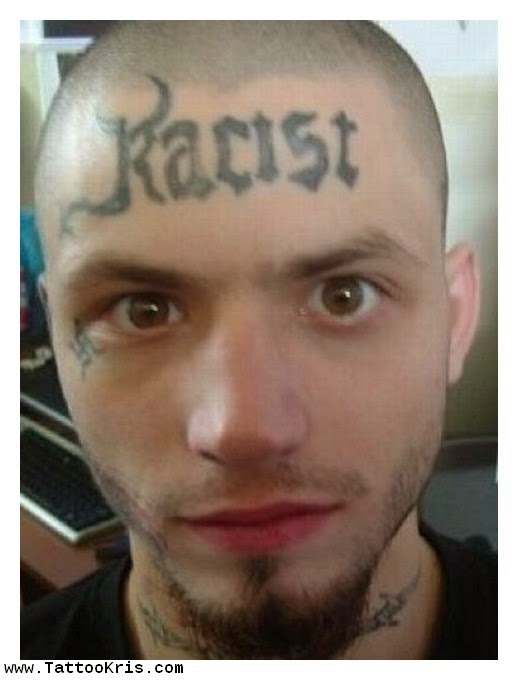
 There are limits to what you should or should not tattoo.  Most shops I have worked at, for example, refused to do tattoos that could be construed as gang-related, racist, or derogatory to sensitive segments of our society.  This is for two reasons.  First, the shop's reputation is on the line.  When you do that kind of tattoo, you become known for doing that kind of tattoo.  Others may come requesting that kind of tattoo, but you may put-off a larger clientele base that would consider being associated with that kind of work distasteful.  It is not worth the trouble.  Second, you are doing that client a favor.  One day, they may realize that the tattoo they thought they wanted to be "in" with the group they where trying to impress has hampered them socially and in finding employment.  Your saying "no" may be saving them years of regret in the future.

 These are solid limits that you should stick by.  Everything else comes down to artistic integrity, which can mean many things.  On the one hand, you as a tattoo artist want to have a body of work that suggests excellence and skill.  A poorly conceived design that the client insists on will not help your cause there.  

Funny until your grand-kids get a roll of quarters.

 However, on the other hand is your integrity as a tattoo artist to serve the client.  It is his or her tattoo, not yours.  Your function is to give the client what they want to the best of your ability.  Refusing to do certain tattoos can harm your reputation; you can be perceived as being "stuck-up" or thinking that you are too good to give someone what they want.  While you may be right about a design being bad, the hurt feelings caused by not doing the tattoo can be more damaging to your reputation than doing a bad tattoo.

 If a client comes in with a design that they commissioned or drew themselves, that design has an inherent emotional value to them.  If you look at the design and see a hot-mess, it is your job to educate the client as to their options.  First, be gentle and kind about the design.  Praise the work of the artist.  Ask how much experience that artist has.  Often, it may only be a few years, which can work to your advantage when you try to convince the client to go another way.  Find something you can say is positive about the design, and talk to the client about why they want it.  That design may be something that someone who has passed away has drawn or has some other sentimental value attached to it.  If that is the case, you do not want to change it, or change it much.  The client is not concerned about the quality of the design, only its sentimental value.

 If it is just a design that the client likes, they can usually be persuaded to let you change it.  This is the time to educate the client on the differences between art and tattoo art.  Explain the limits of the medium, why the design may not work well in the skin, or issues with the design itself you are concerned about (proportion, flow, etc).  Suggest allowing you to re-draw the design to make it more like a tattoo.

I really hope this was drawn by the client.

 If the client insists that they want the design as-is, you can try to price yourself out of the tattoo, although this is not always a good idea.  Show the client your portfolio and discuss your style and your strengths.  This may get the client thinking the design could be better.  If after seeing your portfolio the client still wants the design as-is, offer a price 25-50% above what you would normally charge.  If they ask why it is so expensive, explain the effort that will be required to render that design as accurately as possible and overcoming the limits you described about tattooing.  

 Also, have a client sign an "informed consent" waiver, a document that states that you, as the tattooer, have explained that the design selected is ill-advised, and you have discussed with them the limits of the tattoo process and potential issues they may face.  While it won't save your reputation if the client a year from now tries to blame you for a bad design to their friends (why did he let me get this tattoo?), it will give them another moment to re-think what they are doing.

 When you tattoo a design that you do not like, a huge mistake is made if you do not give it the same effort and attention that you would a design you do like.  A design you do not like should be given more effort, to make it as good as possible.  Every line should be clean and every color solid; cut no corners.  Even if the design is bad, the tattoo itself should be excellent.

 Finally, take a photo of the design and the tattoo side-by-side.  This can work to your advantage in your portfolio.  The design may be bad, but future clients can see just how precise and accurate your were in it's rendering, and they can see that the client elected to get that design, as it is distinct from the other tattoos in style and format in your portfolio.

 It is tempting for a tattooer to limit themselves to tattoos that they like or are in a style they appreciate.  It is good to know your limits; one who is not experienced in doing portraits should probably explain to a client who wants a portrait that it is not your thing.  That is being responsible.  Sticking to your style in other matters, however, should not be a major concern until the demand for your style is so great that you are turning down tattoos due to being booked months in advance.  

 Keep in mind also that it is not just your reputation on the line, but your shops as well.  The shop has a stake in every client that walks through their doors beyond their percentage.  The advertising dollars spent brought that client into the shop, which means every client that comes in is an opportunity to recoup that cost that should not be wasted. A client who does not get what they want from a shop will not talk about the snooty artist, but the snobby shop that refused to give them their tattoo.  The shop they go to that does do the tattoo will only encourage this way of thinking in their minds.

Actually tried to sue her artist over this choice.

 Finally, it may not be the design that is objectionable, but the placement.  The hand or facial tattoo will impact that client for the rest of their life.  That silly tattoo across their ass may seem cute now, but not so cute in twenty years.  Advise the client as best you can about the potential risks, and if they insist, video-tape the process and use it for advertising.  

 The bottom line is that tattooing is a service-industry.  We give our clients what they want to the best of our ability.  Do your best to give them a great tattoo, and if they insist on a poor design at least they will get it fully aware of your concerns and in a manner that is as technically sound as possible.


 Jason Sorrell is a writer, tattoo artist, satirist, artist, and generally nice guy living in Austin, TX.  He loves answering questions about tattoos.  Shoot him a message at https://www.facebook.com/tattoonerdz/