Showing posts with label choice. Show all posts

Tuesday, February 14, 2017

Claim your ink


 I have probably discussed this topic in several different ways, but it bears repeating. I also recently did a tattoo consultation so it is fresh in my mind?

 Don’t know what a tattoo consultation is? You need a better tattooer.

 So, you are thinking about getting a tattoo, but you are not certain what you want. You have a concept, but that is about it. How does one get from a fuzzy idea in their head to the actual tattoo? Talking to a tattooer is a great start, but there is a lot you can do before you have that conversation.

 1. Determine what the tattoo means to you. If you want a military tattoo to honor a family member, you may want other items as filler related to that person. If a military tattoo is meant to be a reflection of your own service, then filler could be other aspects of that service. The meaning of the tattoo could take your concept in different directions.

 2. Once you have an idea, start looking for references. Collect images of things related to your concept, even if they are just things that could be part of your tattoo.

 3. Add to these concept references tattoo references; images of tattoos that you like. This serves two purposes; it will help to define the style of tattoo you want, and it will also indicate the limitations of tattoo design relative to your other reference material.

 What I mean by that is you will develop an understanding that the three-dimensional CGI image you have as a reference will look different when rendered as a tattoo. It may sound obvious, but people often seem to think anything can be rendered as a tattoo in the skin.

4. Identify your tattoo style. As you are collecting references of tattoos you like (related to your concept or not), a stylistic theme may emerge. You need not know that you are looking at American Traditional designs, but recognizing that you like this type of tattoo more than another, and being able to provide your tattooer examples, will help bring your design to life.

5. Determine where on your body you will get your tattoo. Location will impact both the size of the tattoo and how the design is organized. A design created for a forearm is often not the same as one created for a shoulder.

6. Be realistic about the limitations of the tattoo design and the style you want. More often than not, images rendered as a tattoo are simplified. Location on your body and size limitations also impact the amount of detail that can be reasonably included.
7. Be aware that you concept may be interpreted in multiple ways, and be prepared to allow the tattooer some creative input on the design. Your tattooer will have more experience with design as it is applied to tattoos; how certain elements should be arranged given the location of the tattoo and the style, what colors will work best and in what combinations, and so on.

8. The flipside of the same coin is being certain that the design is what you really want. If you feel pressured to depart from your ideas in a way that you do not like, or that the rendering is not living-up to your expectations, then don’t get the tattoo. The design should be something you are excited about getting, and your tattoo should be flexible enough to get it to where you want (within reason).

9. Decide if this will be your only tattoo for a while, or if it will be the first of many in the same location on your body. If your tattoo plan includes additional tattoo building on or being near the current tattoo, those future plans need to be taken into account in the design.


10. Be responsible for your tattoo and take your time. Do your research, look at portfolios, and talk to a number of tattooers. Ideally, you want an experienced tattooer who works in your chosen style and who is excited about the project. A tattoo is an investment, so take you time with it.

 Jason Sorrell is a writer, tattoo artist, satirist, artist, and generally nice guy living in Austin, TX.  He loves answering questions about tattoos.  Shoot him an email at https://www.facebook.com/tattoonerdz/

Tuesday, December 2, 2014

What to Do When Someone Wants a Bad Tattoo

 This question was posed in a forum I follow:

 "We've all had clients walk in with a poorly rendered design that their sister/cousin/whoever has drawn for them that you know will end-up on a tattoo-fail-blog.  A design or concept you would not want your name attached to.  I take pride in my work and have gotten in trouble for refusing to do a tattoo someone requested, but it is my career and not the shop-owner's.  How do you handle it?"

 It happens.  Someone walks in with an ill-conceived design or concept.  It could be as simple as something that might be a wonderful piece of art but does not translate well into a tattoo.  Or, it could be something that is badly drawn that the client insists they want as is.  How should this be handled?

A questionable potential client...


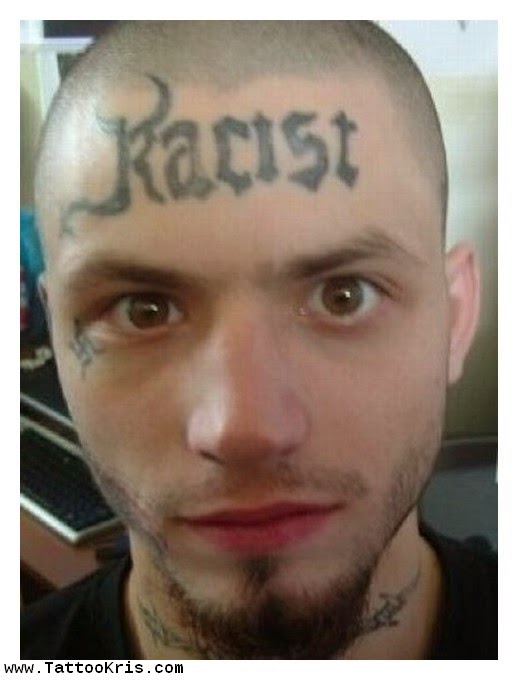
 There are limits to what you should or should not tattoo.  Most shops I have worked at, for example, refused to do tattoos that could be construed as gang-related, racist, or derogatory to sensitive segments of our society.  This is for two reasons.  First, the shop's reputation is on the line.  When you do that kind of tattoo, you become known for doing that kind of tattoo.  Others may come requesting that kind of tattoo, but you may put-off a larger clientele base that would consider being associated with that kind of work distasteful.  It is not worth the trouble.  Second, you are doing that client a favor.  One day, they may realize that the tattoo they thought they wanted to be "in" with the group they where trying to impress has hampered them socially and in finding employment.  Your saying "no" may be saving them years of regret in the future.

 These are solid limits that you should stick by.  Everything else comes down to artistic integrity, which can mean many things.  On the one hand, you as a tattoo artist want to have a body of work that suggests excellence and skill.  A poorly conceived design that the client insists on will not help your cause there.  

Funny until your grand-kids get a roll of quarters.

 However, on the other hand is your integrity as a tattoo artist to serve the client.  It is his or her tattoo, not yours.  Your function is to give the client what they want to the best of your ability.  Refusing to do certain tattoos can harm your reputation; you can be perceived as being "stuck-up" or thinking that you are too good to give someone what they want.  While you may be right about a design being bad, the hurt feelings caused by not doing the tattoo can be more damaging to your reputation than doing a bad tattoo.

 If a client comes in with a design that they commissioned or drew themselves, that design has an inherent emotional value to them.  If you look at the design and see a hot-mess, it is your job to educate the client as to their options.  First, be gentle and kind about the design.  Praise the work of the artist.  Ask how much experience that artist has.  Often, it may only be a few years, which can work to your advantage when you try to convince the client to go another way.  Find something you can say is positive about the design, and talk to the client about why they want it.  That design may be something that someone who has passed away has drawn or has some other sentimental value attached to it.  If that is the case, you do not want to change it, or change it much.  The client is not concerned about the quality of the design, only its sentimental value.

 If it is just a design that the client likes, they can usually be persuaded to let you change it.  This is the time to educate the client on the differences between art and tattoo art.  Explain the limits of the medium, why the design may not work well in the skin, or issues with the design itself you are concerned about (proportion, flow, etc).  Suggest allowing you to re-draw the design to make it more like a tattoo.

I really hope this was drawn by the client.

 If the client insists that they want the design as-is, you can try to price yourself out of the tattoo, although this is not always a good idea.  Show the client your portfolio and discuss your style and your strengths.  This may get the client thinking the design could be better.  If after seeing your portfolio the client still wants the design as-is, offer a price 25-50% above what you would normally charge.  If they ask why it is so expensive, explain the effort that will be required to render that design as accurately as possible and overcoming the limits you described about tattooing.  

 Also, have a client sign an "informed consent" waiver, a document that states that you, as the tattooer, have explained that the design selected is ill-advised, and you have discussed with them the limits of the tattoo process and potential issues they may face.  While it won't save your reputation if the client a year from now tries to blame you for a bad design to their friends (why did he let me get this tattoo?), it will give them another moment to re-think what they are doing.

 When you tattoo a design that you do not like, a huge mistake is made if you do not give it the same effort and attention that you would a design you do like.  A design you do not like should be given more effort, to make it as good as possible.  Every line should be clean and every color solid; cut no corners.  Even if the design is bad, the tattoo itself should be excellent.

 Finally, take a photo of the design and the tattoo side-by-side.  This can work to your advantage in your portfolio.  The design may be bad, but future clients can see just how precise and accurate your were in it's rendering, and they can see that the client elected to get that design, as it is distinct from the other tattoos in style and format in your portfolio.

 It is tempting for a tattooer to limit themselves to tattoos that they like or are in a style they appreciate.  It is good to know your limits; one who is not experienced in doing portraits should probably explain to a client who wants a portrait that it is not your thing.  That is being responsible.  Sticking to your style in other matters, however, should not be a major concern until the demand for your style is so great that you are turning down tattoos due to being booked months in advance.  

 Keep in mind also that it is not just your reputation on the line, but your shops as well.  The shop has a stake in every client that walks through their doors beyond their percentage.  The advertising dollars spent brought that client into the shop, which means every client that comes in is an opportunity to recoup that cost that should not be wasted. A client who does not get what they want from a shop will not talk about the snooty artist, but the snobby shop that refused to give them their tattoo.  The shop they go to that does do the tattoo will only encourage this way of thinking in their minds.

Actually tried to sue her artist over this choice.

 Finally, it may not be the design that is objectionable, but the placement.  The hand or facial tattoo will impact that client for the rest of their life.  That silly tattoo across their ass may seem cute now, but not so cute in twenty years.  Advise the client as best you can about the potential risks, and if they insist, video-tape the process and use it for advertising.  

 The bottom line is that tattooing is a service-industry.  We give our clients what they want to the best of our ability.  Do your best to give them a great tattoo, and if they insist on a poor design at least they will get it fully aware of your concerns and in a manner that is as technically sound as possible.


 Jason Sorrell is a writer, tattoo artist, satirist, artist, and generally nice guy living in Austin, TX.  He loves answering questions about tattoos.  Shoot him a message at https://www.facebook.com/tattoonerdz/
Sunday, February 2, 2014

Custom or Market Flash? Why the Answer is Custom!

 Often, when I talk about "tattoo flash", I get pretty passionate, but other people's eyes glaze over.  "Tattoo flash" is industry lingo.  It refers to designs which are marketed to tattoo studios in sheets or books.  I believe the term either originates from the idea that the sheets being displayed were an indicator that your location was a tattoo studio (it "flashes" to passer-byes) or they were all designs that the artist had drawn so many times that he could literally do them "in a flash".  Old sheets have prices by each design, and before the invention of thermafax stenciling and modern tattoo machines they HAD to be simple designs.  Today, tattoo flash can be very detailed and involved, though they generally are still simple designs.

Cherry Creek is a popular source of "market" flash.
 Tattoo flash comes in two types; market flash and collector flash.  Market flash are sheets of designs that are commonly asked for by clients who walk into a studio simply wanting a tattoo.  Hearts, skulls, daggers, hula-girls, roses, etc, all populated the sheets of market flash.  Studios who display flash favor market flash because that is what sells.  Flash of this sort on display and in use (a key distinction that I will address in a moment) is one of the ear-marks of what is referred to as a "street shop", a shop that makes its money primarily from walk-ins who want simple tattoos. 

 Collector flash is a whole other animal.  Collector flash are made up of designs that are very specialized, displaying the artistic skill of the designer, and are of subjects and/or in styles that appeal more to collectors of tattoo flash (such as tattoo artists), or tattoo collectors who want something radically different as a tattoo.  Collector flash generally does not sell well in a shop, and is used almost exclusively for display purposes, suggesting a style that a shop might pursue or just adding to the atmosphere of the studio.  Occasionally, a studio that bills itself as a "custom tattoo shop" will display collectors flash and some market flash, but the market flash tends to be either very old, by a famous artist, or drawn by one of the artists in the studio.

Jason Sorrell's parody of the market flash sheets.
 I have a soft-spot in my heart for flash, especially collector flash.  I design and sell flash sheets, and my flash sheets helped me earn my apprenticeship.  But, I must admit that as a tattoo artist, I will always prefer to do a custom tattoo.  It has also been my experience that you will get more tattoo for your money when you go custom.  Why?  Because your artist is more invested in a custom piece.

 When you select a flash design for your tattoo, especially from market flash, you are getting a design that may have been tattooed hundreds of time before.  The artist may bring all their skill and expertise  to the design, but ultimately it is a design that has been done and will be done over-and-over again.  It is craft, and not art.  It also does not help the artist further his career.  An artist can only have so many cherry tattoos in their portfolio before it becomes redundant.

 Custom tattoos, on the other hand, allow the artist to bring all their skills and vision to bare.  Flash can be designed for parts of the body, but a custom piece is designed specifically for the body it is being applied to.  The artist and the collector collaborate on the design, so the collector also becomes more invested in the work.  Because of the creative process and excitement generated by the custom tattoo process, an artist will give more in the tattoo.  Each custom tattoo is an opportunity for the artist to demonstrate just how good they really are, and almost always results in a piece being added to their portfolio in order to further their careers.

 You simply get a better tattoo.

Collectors flash by Jason Sorrell.
 As a final note, the second most frequent tattoo I end up covering-up for clients, after names, are flash tattoos.  Most tattooists starting out start with tattoo flash, usually on friends who are willing to be guinea pigs.  Flash tattoos, even when not done by a beginner, tend not to fit the body and were chosen because the client "wanted a tattoo", but had no idea what they wanted.  Having had some time to think about it, they come up with a specific design and regret having already occupied an ideal location on their body with a flash-piece.  Save yourself some regret and some money, go custom.  


Jason Sorrell is a writer, tattoo artist, satirist, artist, and generally nice guy living in Austin, TX.  He loves answering questions about tattoos.  Shoot him a message at https://www.facebook.com/tattoonerdz/