Showing posts with label design. Show all posts

Thursday, October 6, 2016

Createmytattoo.com

 CreateMyTattoo.com is a user-content driven marketplace where tattoo patrons connect with tattoo designers to have a unique tattoo design created, but you probably figured that out based on the name. The way it works is that a patron creates a "Tattoo Contest", pledging at least $20 (but the amounts go up into the hundreds), and gives designers 10-16 days to create a design based on their concept. Along the way, they offer feedback to the designers who can tweak their designs to meet the vision of the patron. At the end of the contest, the patron picks a design (maybe), and the winning designer is paid for the work.

 Now, I know several of my tattoo friends are looking at all that and saying to themselves, "Why would I do that? I don't get paid for my effort unless I win, and I have better things to do with my time." Ah, but my friends, as one who has worked in several tattoo studios, I know that is not the case for most tattooers. I have found it often surprising how little we do with our down-time. Cleaning, equipment maintenance, and drawing for our next client... That tends to be the extent of what many average tattooers do. It is shocking when I think of all the ways a tattooer can be making money as an artist that are not taken advantage of, especially when I can point to the industry leaders who have built their reputations based on what the do in and out of their tattoo stations.

 But, this is not about the money.

 Seriously, this is not about the money.

 First, the positive view.

 I draw a lot. Not as much as I should, in my opinion, but a lot. I tend to draw pinup art. It is my niche. I think we, as artists, all develop a niche, a thing we are good at. That can be problematic, especially if your niche isn't in vogue at the moment, and your clients cannot see the technical skill and style beyond the subject matter.

 And, we all know that most cannot.

 CreateMyTattoo.com provides you are regularly updated list of tattoo concepts that allow you to broaden your scope and refine your style (or, for many new tattooers, begin to discover and define a style). The financial incentive is merely icing on the cake. If you don't win a contest, you still walk away with the following:

 -an addition to your design portfolio.

 -honing of your skill-set.

 -examples of your style be applied to varied subject matter.

 -art which can be applied to other venues (merchandising).

 -an increased public awareness of your name and skills.

 Plus, it gives you something to do with your downtime. Activity attracts activity. 

 And now, the negative view.

 When going through the existing contests, I counted a total of 70+ contests with no winner selected. The rules state that if a patron does not select a design, they cannot legally use any of the submissions.  How many of you have seen that stop a customer from coming in and asking for a tattoo they saw online, or stop less reputable tattooers from copying another person's work? Of those 70+ contests, nearly 900 entries were submitted. That is a lot of effort to have someone just back-out of the process, probably with a tattoo design in hand. 

 This is why it cannot be about the money.

 Most of your competition on the site are clearly not tattooers, that or they are mostly the lowest common denominator among tattooers. Many of the entries are clearly photoshopped copies of designs found on-line. While your initial thinking might be that this would give a solid tattoo designer a huge advantage, most of the winners have been selected from what are low-quality designs. 

 So, then what do I propose as the best way to use the site? Assuming that the contests are being created by actual patrons (and not internally by the site administrators), then it can perhaps be used as a gauge for what are popular tattoo requests. If you post your work to the site through contests, assume that you are giving your work away, but then again this is the assumption every tattooer should make whenever they post their designs online. If you don't post, the site at least provides a source of concepts that you may not have come up with yourself.

 CreateMyTattoo.com might be worth checking out, if one's expectations are really low and you are looking for a little creative shot-in-the-arm.

 Jason Sorrell is a writer, tattoo artist, satirist, artist, and generally nice guy living in Austin, TX.  He loves answering questions about tattoos.  Shoot him an email at https://www.facebook.com/tattoonerdz/

Sunday, May 1, 2016

"Sailor Jerry's Tattoo Stencils" Books I and II

  Before you buy "Sailor Jerry's Tattoo Stencils" by Kate Hellenbrand, you need to understand the title.  I recommend that any aspiring tattooer get a copy of these books, but you need to know what you are getting. This is not, technically, a collection of Norman "Sailor Jerry" Collin's flash.  Rather, these are actual transfers from those flash designs, the first stage of the actual tattoos.  What you will get are raw, unadorned examples of the very foundation of a tattoo.  This collection gathered by Kate "Shanghai Kate" Hellenbrand, demonstrates the root of the "American Traditional" tattoo design, the style that many tattoo purists describe as the defining style of a "good" tattoo.  

 The American Traditional tattoo style developed not from an aesthetic choice, but rather the limitations of the tools used to take a design from paper to the skin.  Before the advent of the thermograph transfer, tattooers would cut their designs into a thin, plastic sheet.  Grooves cut into the acetate would be filled by rubbing graphite into them.  The skin was prepared with a thin coat of petroleum jelly.  The acetate stencil would be laid onto the skin, transferring the graphite from the stencil to the jelly.  This provided a fragile pattern for the tattooer to follow with his needle.

 The nature of this process limited the complexity and detail of the designs.  If a design was too intricate, it would be difficult (if not impossible) and extremely time-consuming to cut into acetate.  Thus, American Traditional designs are defined by simple, bold lines, with often no more than two to three line-widths.  The transfer process and materials also limited selection.  Tattoo designs tended to be limited to what was popular to those getting tattoos in those early years; Naval or other Military images, primitive pin-up girls, and well-known cartoon characters.  The same acetate stencil would be the basis for multiple tattoos, with variation introduced during the tattoo process.

 Color in these tattoos, usually red, green, blue, yellow, and black, were also limited by the technology of the time.  Tattooers often made their own ink, and there were limits to what could be successfully and economically produced.  Again, the American Traditional style was a result not of aesthetics, but of the practical limitations of the technology of the time.  These limitations came to set the expectations of what a tattoo should look like.  Today, technological advancements allows for a variety of styles to be replicated in the skin, but "Tattoo Art" has become defined in the social consciousness as consisting of strong lines, a bold but limited color pallet, and traditional subject matter.  Put simply, this style is recognized as a tattoo, regardless if it is in skin or on paper.

 These collections offer insight into the foundations of an art form.  With an understanding of the technical limitations, they also highlight the innovative and creative talent of Sailor Jerry.  While these books will have very little value to most tattoo clients seeking a design, they represent an excellent resource for the tattooer who wishes to create tattoo designs rooted in traditional methods and recognized as tattoo art.

 Jason Sorrell is a writer, tattoo artist, satirist, artist, and generally nice guy living in Austin, TX.  He loves answering questions about tattoos.  Shoot him a message at https://www.facebook.com/tattoonerdz/

Tuesday, December 2, 2014

What to Do When Someone Wants a Bad Tattoo

 This question was posed in a forum I follow:

 "We've all had clients walk in with a poorly rendered design that their sister/cousin/whoever has drawn for them that you know will end-up on a tattoo-fail-blog.  A design or concept you would not want your name attached to.  I take pride in my work and have gotten in trouble for refusing to do a tattoo someone requested, but it is my career and not the shop-owner's.  How do you handle it?"

 It happens.  Someone walks in with an ill-conceived design or concept.  It could be as simple as something that might be a wonderful piece of art but does not translate well into a tattoo.  Or, it could be something that is badly drawn that the client insists they want as is.  How should this be handled?

A questionable potential client...


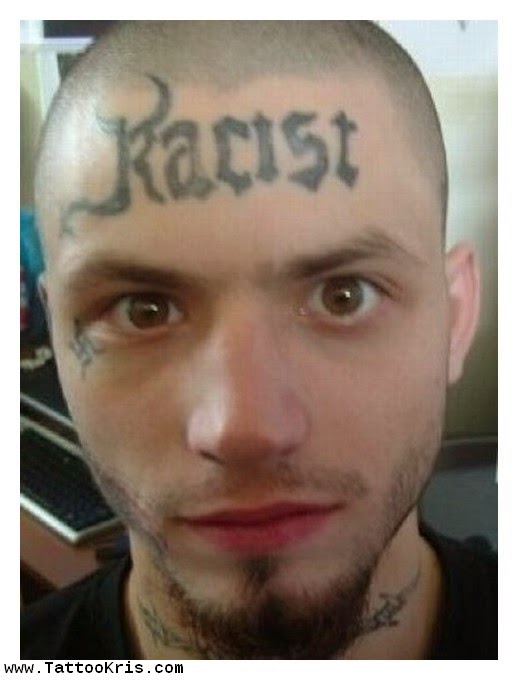
 There are limits to what you should or should not tattoo.  Most shops I have worked at, for example, refused to do tattoos that could be construed as gang-related, racist, or derogatory to sensitive segments of our society.  This is for two reasons.  First, the shop's reputation is on the line.  When you do that kind of tattoo, you become known for doing that kind of tattoo.  Others may come requesting that kind of tattoo, but you may put-off a larger clientele base that would consider being associated with that kind of work distasteful.  It is not worth the trouble.  Second, you are doing that client a favor.  One day, they may realize that the tattoo they thought they wanted to be "in" with the group they where trying to impress has hampered them socially and in finding employment.  Your saying "no" may be saving them years of regret in the future.

 These are solid limits that you should stick by.  Everything else comes down to artistic integrity, which can mean many things.  On the one hand, you as a tattoo artist want to have a body of work that suggests excellence and skill.  A poorly conceived design that the client insists on will not help your cause there.  

Funny until your grand-kids get a roll of quarters.

 However, on the other hand is your integrity as a tattoo artist to serve the client.  It is his or her tattoo, not yours.  Your function is to give the client what they want to the best of your ability.  Refusing to do certain tattoos can harm your reputation; you can be perceived as being "stuck-up" or thinking that you are too good to give someone what they want.  While you may be right about a design being bad, the hurt feelings caused by not doing the tattoo can be more damaging to your reputation than doing a bad tattoo.

 If a client comes in with a design that they commissioned or drew themselves, that design has an inherent emotional value to them.  If you look at the design and see a hot-mess, it is your job to educate the client as to their options.  First, be gentle and kind about the design.  Praise the work of the artist.  Ask how much experience that artist has.  Often, it may only be a few years, which can work to your advantage when you try to convince the client to go another way.  Find something you can say is positive about the design, and talk to the client about why they want it.  That design may be something that someone who has passed away has drawn or has some other sentimental value attached to it.  If that is the case, you do not want to change it, or change it much.  The client is not concerned about the quality of the design, only its sentimental value.

 If it is just a design that the client likes, they can usually be persuaded to let you change it.  This is the time to educate the client on the differences between art and tattoo art.  Explain the limits of the medium, why the design may not work well in the skin, or issues with the design itself you are concerned about (proportion, flow, etc).  Suggest allowing you to re-draw the design to make it more like a tattoo.

I really hope this was drawn by the client.

 If the client insists that they want the design as-is, you can try to price yourself out of the tattoo, although this is not always a good idea.  Show the client your portfolio and discuss your style and your strengths.  This may get the client thinking the design could be better.  If after seeing your portfolio the client still wants the design as-is, offer a price 25-50% above what you would normally charge.  If they ask why it is so expensive, explain the effort that will be required to render that design as accurately as possible and overcoming the limits you described about tattooing.  

 Also, have a client sign an "informed consent" waiver, a document that states that you, as the tattooer, have explained that the design selected is ill-advised, and you have discussed with them the limits of the tattoo process and potential issues they may face.  While it won't save your reputation if the client a year from now tries to blame you for a bad design to their friends (why did he let me get this tattoo?), it will give them another moment to re-think what they are doing.

 When you tattoo a design that you do not like, a huge mistake is made if you do not give it the same effort and attention that you would a design you do like.  A design you do not like should be given more effort, to make it as good as possible.  Every line should be clean and every color solid; cut no corners.  Even if the design is bad, the tattoo itself should be excellent.

 Finally, take a photo of the design and the tattoo side-by-side.  This can work to your advantage in your portfolio.  The design may be bad, but future clients can see just how precise and accurate your were in it's rendering, and they can see that the client elected to get that design, as it is distinct from the other tattoos in style and format in your portfolio.

 It is tempting for a tattooer to limit themselves to tattoos that they like or are in a style they appreciate.  It is good to know your limits; one who is not experienced in doing portraits should probably explain to a client who wants a portrait that it is not your thing.  That is being responsible.  Sticking to your style in other matters, however, should not be a major concern until the demand for your style is so great that you are turning down tattoos due to being booked months in advance.  

 Keep in mind also that it is not just your reputation on the line, but your shops as well.  The shop has a stake in every client that walks through their doors beyond their percentage.  The advertising dollars spent brought that client into the shop, which means every client that comes in is an opportunity to recoup that cost that should not be wasted. A client who does not get what they want from a shop will not talk about the snooty artist, but the snobby shop that refused to give them their tattoo.  The shop they go to that does do the tattoo will only encourage this way of thinking in their minds.

Actually tried to sue her artist over this choice.

 Finally, it may not be the design that is objectionable, but the placement.  The hand or facial tattoo will impact that client for the rest of their life.  That silly tattoo across their ass may seem cute now, but not so cute in twenty years.  Advise the client as best you can about the potential risks, and if they insist, video-tape the process and use it for advertising.  

 The bottom line is that tattooing is a service-industry.  We give our clients what they want to the best of our ability.  Do your best to give them a great tattoo, and if they insist on a poor design at least they will get it fully aware of your concerns and in a manner that is as technically sound as possible.


 Jason Sorrell is a writer, tattoo artist, satirist, artist, and generally nice guy living in Austin, TX.  He loves answering questions about tattoos.  Shoot him a message at https://www.facebook.com/tattoonerdz/

Sunday, February 2, 2014

Custom or Market Flash? Why the Answer is Custom!

 Often, when I talk about "tattoo flash", I get pretty passionate, but other people's eyes glaze over.  "Tattoo flash" is industry lingo.  It refers to designs which are marketed to tattoo studios in sheets or books.  I believe the term either originates from the idea that the sheets being displayed were an indicator that your location was a tattoo studio (it "flashes" to passer-byes) or they were all designs that the artist had drawn so many times that he could literally do them "in a flash".  Old sheets have prices by each design, and before the invention of thermafax stenciling and modern tattoo machines they HAD to be simple designs.  Today, tattoo flash can be very detailed and involved, though they generally are still simple designs.

Cherry Creek is a popular source of "market" flash.
 Tattoo flash comes in two types; market flash and collector flash.  Market flash are sheets of designs that are commonly asked for by clients who walk into a studio simply wanting a tattoo.  Hearts, skulls, daggers, hula-girls, roses, etc, all populated the sheets of market flash.  Studios who display flash favor market flash because that is what sells.  Flash of this sort on display and in use (a key distinction that I will address in a moment) is one of the ear-marks of what is referred to as a "street shop", a shop that makes its money primarily from walk-ins who want simple tattoos. 

 Collector flash is a whole other animal.  Collector flash are made up of designs that are very specialized, displaying the artistic skill of the designer, and are of subjects and/or in styles that appeal more to collectors of tattoo flash (such as tattoo artists), or tattoo collectors who want something radically different as a tattoo.  Collector flash generally does not sell well in a shop, and is used almost exclusively for display purposes, suggesting a style that a shop might pursue or just adding to the atmosphere of the studio.  Occasionally, a studio that bills itself as a "custom tattoo shop" will display collectors flash and some market flash, but the market flash tends to be either very old, by a famous artist, or drawn by one of the artists in the studio.

Jason Sorrell's parody of the market flash sheets.
 I have a soft-spot in my heart for flash, especially collector flash.  I design and sell flash sheets, and my flash sheets helped me earn my apprenticeship.  But, I must admit that as a tattoo artist, I will always prefer to do a custom tattoo.  It has also been my experience that you will get more tattoo for your money when you go custom.  Why?  Because your artist is more invested in a custom piece.

 When you select a flash design for your tattoo, especially from market flash, you are getting a design that may have been tattooed hundreds of time before.  The artist may bring all their skill and expertise  to the design, but ultimately it is a design that has been done and will be done over-and-over again.  It is craft, and not art.  It also does not help the artist further his career.  An artist can only have so many cherry tattoos in their portfolio before it becomes redundant.

 Custom tattoos, on the other hand, allow the artist to bring all their skills and vision to bare.  Flash can be designed for parts of the body, but a custom piece is designed specifically for the body it is being applied to.  The artist and the collector collaborate on the design, so the collector also becomes more invested in the work.  Because of the creative process and excitement generated by the custom tattoo process, an artist will give more in the tattoo.  Each custom tattoo is an opportunity for the artist to demonstrate just how good they really are, and almost always results in a piece being added to their portfolio in order to further their careers.

 You simply get a better tattoo.

Collectors flash by Jason Sorrell.
 As a final note, the second most frequent tattoo I end up covering-up for clients, after names, are flash tattoos.  Most tattooists starting out start with tattoo flash, usually on friends who are willing to be guinea pigs.  Flash tattoos, even when not done by a beginner, tend not to fit the body and were chosen because the client "wanted a tattoo", but had no idea what they wanted.  Having had some time to think about it, they come up with a specific design and regret having already occupied an ideal location on their body with a flash-piece.  Save yourself some regret and some money, go custom.  


Jason Sorrell is a writer, tattoo artist, satirist, artist, and generally nice guy living in Austin, TX.  He loves answering questions about tattoos.  Shoot him a message at https://www.facebook.com/tattoonerdz/

Monday, June 24, 2013

How a Tattoo is Priced


"A Good Tattoo Isn't Cheap.  A Cheap Tattoo Isn't Good."

 This is simply a truism about tattoos that is applicable almost universally with a few rare instances or circumstances that disprove the rule. It is ALWAYS in your best interest to shop for quality.  Pricing a tattoo is a subjective art.  Prices are offered as either a flat-rate, generally for small tattoos, or an hourly rate for larger pieces.  A price on a tattoo is open to negotiation, within limits, and is dependent on what the artist thinks his or her effort is worth, how much they want to do the tattoo, and how much they need to do the tattoo.

 As a collector, pricing should be your last consideration when getting a tattoo.  First you should be concerned about the quality and reputation of the shops you are considering.  Then you should find a knowledgeable artist in a reputable shop who is skilled in the style and subject matter you are interested in.  After those concerns have been addressed, then it is time for you to discuss price.  It is worth your money to get your work from a good shop and an artist who knows what they are doing.  A tattoo is an investment in yourself, so don't go cheap.

 The price of a tattoo may be presented as either flat rate or an hourly rate.  An artist who offers a flat rate comes up with an estimate of what a tattoo of that design's complexity, number of colors, size, and location on the body will cost for him to do.  Artist develop an eye for pricing based on the size and complexity of the design with a rough idea to how long it will take them to do and what they wish to make per hour.  If the tattoo is on a spot that presents its own issues; feet, hands, ribs, chests, breasts, or intimate areas, then the artist adjusts the price up to compensate.  A flat rate is typically offered for small tattoos or pre-designed (tattoo flash) tattoos.  The advantage of flat-rate pricing is that both the client and the artist know exactly how much money will be exchanged for the tattoo.

 An hourly rate is typically offered on large pieces that will take several sessions to complete.  Again, the artist knows how much they would like to earn an hour, and can probably offer an estimate of how long a tattoo might take, but due to the tattoos size the exact amount of time is uncertain.  Tattoo sleeves, socks, body-suits, back pieces, touch-ups, and cover-ups are often offered at an hourly rate.  The advantage of hourly-pricing is that the tattoo can be broken down into sessions, with segments of time being purchased by the collector from his artist.  The collector does not need to pay for the entire tattoo up-front, and on future sessions can pay only the amount that is comfortable for them, getting a smaller or larger amount of work depending on the amount paid.

 Tattoo pricing is subjective, and generally open to negotiation.  Rare is an artist or shop that has a rate on any tattoo "set".  A tattoo artist typically offers a price for what they think is fair for their effort.  While some artists may try to "size-up" their customer and offer a price based partially on what they think the customer may be able to pay, this is considered an unprofessional and unnecessary practice.  If your work is worth $200 an hour, it will fetch $200 an hour regardless of a particular customer's ability to pay.

 The price offered, however, may not be the final word on the tattoo price.  This is because a tattoo artist is driven by other motivators than money alone.  The tattoo artist may very much want to do your tattoo.  The design you have selected or the concept you have in mind may be intriguing to the artists and something he or she would like to have in their portfolio.  This is why it is beneficial to seek an artist who's style you enjoy and who has some familiarity with the subject matter.  An artist who wants to do your tattoo may be willing to take less than they normally would to do the work.

 Another factor is how badly the artist needs to do your tattoo.  Tattoo artists have bills to pay like everyone else.  If an artist is feeling the crunch from upcoming bills, has expensive plans in the future, or if he or she  is having a slow day, then their may be room for negotiation.  While you cannot possibly know when an artist's bills are due or what their plans are, you know that their rhythms probably coincide with the rest of society.  Thus, the end of the month and the middle of the month might be more needful times for an artist.  Also, since a tattoo artist makes most of his or her money on the weekends, Monday through Thursday are probably a little less expensive days to visit an artist than Friday through Sunday.  The less the artist has going on, the more likely they are to charge less to simply earn some money on a slow day.

 Negotiation should always be considered a possibility.  It never hurts to ask if you can get a better price.  How you ask, and how you respond, can either help or hurt your price.  They may not look it, but tattoo artists can be a little on the sensitive-side when it come to their work.  Telling an artist that they are asking for too much for a "drawing on the skin" tells the artist you have no respect for the industry or for them as an artist.  Generally, a tattoo artist offers what they feel is a fair price for the work requested, so questioning their judgement suggests you lack confidence in their skills.  Telling an artist that you have gotten better offers from other tattoo artists or shops is also a poor strategy.  More often than not, you will be invited to seek that artist, and to come back for an even more expensive cover-up (because you get what you pay for).

 The best strategy for negotiating the price if the price offered is out of your comfort zone is to simply say so. "That is more than I am prepared to pay, but I really want the work" almost always gets some wiggle-room on the price.  The artist may come down a small amount, which is usually the least they will take to do the tattoo, or they may ask what you are hoping to pay for the work.  The artist will take that information and may offer to do a smaller or less detailed version of your design, or offer to do the work in sessions.  In any case, letting the artist know that you want the work, but are simply short on cash, is far better than suggesting the work is over-priced or that a better deal can be gotten elsewhere.

 Again (because this point cannot be emphasized enough), pricing should be your last concern when getting a tattoo.  If you find a reputable and safe tattoo studio with an artist who is skilled in the style you like and is enthusiastic about your tattoo, they will more than likely work with you on a price and give you a tattoo that is worth every penny.  A little research can go a long way toward saving not just cash, but regret over your tattoo in the future.  Finding just the right shop and artist for you can also go a long way toward saving you money on future tattoos.  Keep in mind, while you are saving money on ink, that artists take tips, and a good tip can also lead to savings in the future.

Jason Sorrell is a writer, tattoo artist, satirist, artist, and generally nice guy living in Austin, TX.  He loves answering questions about tattoos.  Shoot him a message at https://www.facebook.com/tattoonerdz/
Wednesday, June 5, 2013

Do You Want a Tattoo? Things to Consider Before Getting Your First Tattoo.

 Getting a tattoo should not be a spur-of-the-moment decision, although it often is.  The tattoo you got that night out partying with your friends might be a momento of  a wonderful evening when you let your hair down, but more often than not it is a reminder of why you should not drink in excess.  Getting a tattoo should be a carefully thought out decision, not just what and where but if you should even get one.  Here are some questions to consider before getting your first tattoo.

 1) Are you comfortable with a "permanent" marking in your skin?


 Tattoos are "permanent".  While they may fade and distort in time, your tattoo will more than likely be in your skin well after you have vacated your body.  A tattoo is a permanent "wound" in your skin.  The ink is inserted into your dermis, or your second layer of skin, where your immune system seals what it cannot carry away.  Barring laser-removal treatment (which is far more expensive than the tattoo itself and not 100% successful), your tattoo will be around for your grandchildren to ask you about.  Are you willing to make that kind of commitment to having a design on your body, any design, and are you willing to live with the potential fall-out from friends, family, and employers for having ink?   If so, then a tattoo may be worth getting.


 2) Are you getting a tattoo for you, or because someone else wants you to?

 Your tattoo is your tattoo.  It should be a reflection of who you are, what is important to you, or a way for your to enhance your image.  You will have your tattoo for life, and no one else can live your life but you.  Getting a tattoo because someone wants you to is just a bad idea, especially when it comes to getting the name of your significant other.  Doing so is often the "kiss of death" in a relationship, done as a show of commitment or fidelity while not being willing to take actual steps toward officiating that relationship.  The WORST thing I've seen is when one person in the relationship is getting the other's name, but the other person is not getting their name.  Ask yourself, if the only reason your getting the tattoo is because person X is in your life, would you still want it if they were not?  If the answer is no, you would not get this tattoo without person X being around to appreciate it, then do not get the tattoo.

 3) Do you handle pain well? 

 In case you have not heard, tattoos hurt.  While it is no where near an unbearable amount of pain, it is a sensation that must be endured if you want a tattoo, often for several hours.  The more ticklish or sensitive the spot on the body, the more it will hurt.  I liken the pain to a cat-scratch across a sunburn.  It will get your attention.  Your tattoo may require multiple sessions as well as a "touch-up" session.  Touching up the wounded area will hurt even more.  On average, a tattoo takes about 6 months to heal, although most tattoos can be touched-up after 2 weeks.
 The pain of the tattoo needle is not the only part that may hurt.  To give you your tattoo, you may need to sit or lay in an awkward position for long periods of time.  You may feel nauseous or light-headed during your tattoo.  Days after the tattoo, you may experience stiffness in the area that was tattooed.  The phrase "short is the pain, long is the ornament" expresses how most tattooed people feel about the pain aspect of their work, but while getting a tattoo the pain will not seem "short".  Numbing creams and pain killers have little effect, and can actually make the pain more difficult to endure.
 So, if you get a tattoo, be prepared to deal with some irritation.

4) Are you aware of the health risks involved?


 Even under the best of conditions, there are health risks involved in getting a tattoo.  Your skin will have a large area abraded and a foreign substance inserted into it.  The abrasion will take several weeks or even months to heal, and will be open to potential infection during that healing process.  The substances used to create the pigments and the carrier for your ink may cause an allergic reaction in some, further complicating the healing process and increasing the risk of infection.

 Furthermore, not all conditions are ideal.  When even the best shops can have health problems arise from the nature of tattooing, the high demand for tattoos means that many disreputable persons and establishments are offering tattoos while not adhering to the strictest standards.  In addition, most shops require you to sign a waiver absolving them of any responsibility for the inherent risks involved in your tattoo.  If something does happen, your not likely to be able to sue the shop involved.
 Poor aftercare is the biggest contributor to health issues.  The shop you got your tattoo in is probably cleaner than your home and where you work.  The instructions your artist gives you to care for your tattoo only decrease the likelihood of problems and ONLY IF YOU FOLLOW THEM.  Tattoo clients are loathe to admit it, but the majority of issues while healing are the result of poor aftercare.
 Finally, if you have special health concerns like a compromised immune system, hemophilia, diabetes, or you are prone to seizures, you should consult a physician before getting a tattoo.  While tattoo artists are generally knowledgeable and experienced with such issues, only your health provider can provide any real assurance that you are healthy enough to be tattooed.  

 5) Will you be tolerant of any social backlash for being tattooed?

 Yes, we have come a long way as an industry since the days when tattoos were considered exclusively for sailors, criminals, and harlots.  Still, some people maintain a grudge against tattoos.  Many look upon getting a tattoo as taking an unnecessary risk, both with your health and your social-status.  Having a tattoo to some suggests that you are irresponsible. Some employers frown on tattoos (a recent study suggested that more than half of the hiring managers who have tattoos THEMSELVES would not hire a tattooed applicant), and many religions and religious organizations take a dim view of tattoos. While you intend for your ink to be a personal expression, you cannot predict how people will receive it, and you may give an impression you did not intend.

 6) Are you willing to do some research before getting a tattoo?

 Far too often, a client will walk into a tattoo studio and ask to see some designs.  They have no idea what they want.  All they know is that they want a tattoo.  Often, it is their first tattoo, and they want it for whatever rewards they think being tattooed will bring them.  Getting a tattoo is a process, and the more you understand about that process, the happier you will be with your ink.  Take your time to decide on a design or at least a concept, including placement on the body, that you really want.  Visit several shops and discuss your idea with different artists, getting their feedback about your design.  Look at portfolios and check out the studio's reputation.  When you settle on a studio and an artist, negotiate price and be prepared to pay what the artist is asking for.  Going for less tattoo because you cannot afford it in one session leaves you with a tattoo you may regret, and trying to "low-ball" your artist just frustrates the guy who may be sticking you with a needle for several hours.

 7) Are you prepared to be responsible for how your tattoo turns out?

 A tattoo is an elective process.  The function of the artist and the studio is to facilitate the process of giving you a tattoo.  You pick the design.  You select the shop and the artist.  You determine the location on your body for the tattoo.  Others may have some suggestions, but ultimately the decisions are yours to make.  Most studios will require that you sign a waiver stating that you understand that a tattoo is a permanent marking, that the process is painful, that their are risks, and that you assume full responsibility for those risks. This includes issues with the tattoo that arise during and after the procedure.  Once you sign that document, you are absolving your artist and your studio of any responsibilities for your tattoo.  Most studios and artists want to maintain a good reputation and relationship with their clients and will work with you if problems arise, but it is ultimately on you.

 8) Is there an alternative to getting a tattoo that you would be happier with?

 A number of options exist for those who think they might want a tattoo but aren't certain.  T-shirts and "tattooed sleeves" are available to give anyone the look of having tattoos without having ever been touched by a tattoo needle.  Adult temporary tattoos can be purchased pre-made or printed from your home computer.  Latex paint, cosmetic airbrushing, and body-markers can all provide a temporary alternative to being tattooed.  Henna tattoos stain the skin for as much as three weeks.  Any of these options provide a sense of what having a tattoo is like without the pain or the commitment.

 9) Are you prepared for your tattoo to change as you age and your body changes?

 Tattoos are in the skin.  The grow, stretch, shrink, and wrinkle as the skin changes.  Your body will never stop trying to remove the ink from your skin, thus the tattoo will blur and fade.  Exposure to sunlight or abrasive materials and procedures may also damage your tattoo.  While different products exist to help preserve your tattoo, these can only limit the effects of time.  The tattoo is a "permanent" mark, but its appearance can change drastically as your body changes.  

 With these things in mind, you may be ready for your first tattoo.  Take your time making your decision.  A tattoo is an investment in your personal expression and identity, and should not be gotten hastily. 

Jason Sorrell is a writer, tattoo artist, satirist, artist, and generally nice guy living in Austin, TX.  He loves answering questions about tattoos.  Shoot him a message at https://www.facebook.com/tattoonerdz/

Monday, May 27, 2013

Tattooing in Trade

 "Trade Work" is something that most tattoo artists do now and then.  You need your car fixed, and you run into an auto-mechanic who is looking for tattoo work, so you work out a trade.  You need a new cellphone and want to upgrade, not necessarily to the latest model but something better than the dinosaur you carry in your pocket.  So, you post an add saying you will trade tattoos for a phone and pick from what is offered.

 Being willing to work in trade is usually good for the client and for the tattooist. Both get something they want by either doing something they enjoy doing or by not having to shell out a wad of cash for something they want.  Most tattooist do trade work "occasionally", and typically do not advertise that they are willing to do so unless they need something.  With the economy being what it is, being willing to work in trade can be a lucrative practice, if you know what you are doing.

 One of the negatives of working in trade is the perception that doing so cheapens your work.  Other professions generally do not work in trade... or at least that is the perception.  In fact, doctors, lawyers, and other professionals often trade their services with clients who have something to offer them, but those transactions are usually above the head of John Q. Public.  Being a tattooist, essentially an independent contractor in most shops, affords us the opportunity to set our own rates and methods of exchange.  However, rule number one in doing trade work is to make certain you and the owner of your studio have a mutual understanding of not only that you are doing tattoos in trade, but how you are advertising the fact and what the split will be on a tattoo done in trade.

 Generally, it is not a good idea to advertise that you are working in a particular shop when doing trade work, as it again may lessen your standing in some people's eyes.  Also, if you represent the shop as doing work for trade, it is likely that people will show up expecting all the artist in your shop to do so, even if it just you.  You do not want the studio to be perceived as a kind of pawnshop.

 You should also trade in items that you are somewhat familiar with.  It is in the nature of the game for clients to over-estimate the value of their trade, and if you do not know enough about what it is you are trading for you may be taken advantage of.  The more familiar you are with what you are trading for the better off you will be.

 As I said, the client will almost always over-estimate the value of what they are trading for.  They may not take into account depreciation and expect to receive for their item what they paid for it.  They might assume that the collector's value immediately equates to what the item will sell for on the market (it almost never does).  You must do your homework!  Have a venue to sell your trades, like eBay.  Inform your clients that you will estimate the value of the item based on WHAT IT IS BEING BID FOR on eBay.  Stress this point to them.  The "Buy Now" price for a new item does not apply to their used item on auction.  However you determine the value of an item, stick to your guns.

 A good trade is one where both sides come away feeling like while they didn't get all they could, they did better than they might have.  This is another tact to take when haggling over the value of an item... And, you will haggle.  If the client feels that the value of an item is more than you are willing to offer, they can sell the item on their own and come back to you with the cash, pocketing the excess for themselves.  Your willingness to trade should be viewed as a convenience to the client, not a need you are fulfilling for yourself. A good rule of thumb is to take whatever you think you will get for your trade and reduce that amount by 20%.  That is not for the client, but to set the proper expectations for yourself and your shop.  It may mean that you do a $200 tattoo for a $150 item, but if you and the shop expect to only get $150, then no one will be disappointed.

 Be prepared to inspect the item, confirming its function and authenticity before doing the tattoo.  If you trade for a video-game system, have a television and a game for the system on hand and play a few rounds.  Also, when trading for an item, insist that all its components be included.  Do not take electronics without a power-cord, for example.  If the client tells you that a power-cord can be purchased with ease for a little cash, advise them that is should not be a problem for them to make the purchase based on their assessment.  ALWAYS be suspect of every trade!

 When selling your traded items, the fastest method is not always the best!  Be prepared to take a week to sell your newly acquired treasure.  Running down to the pawnshop is never a good idea.  With this in mind, have your finances arranged to have the needed time to covert your item to the amount in cash you expected to receive.  If you are trading because the bills are due next week, you should re-think your situation and insist on cash upfront.

 How you split your earnings with the shop will depend on your shop's owner.  Most will let you use the same split for cash tattoos; if you priced the tattoo at $200, you think that is what you will get for your trade, and your split is 60/40, you will owe your shop $80.  Your shop owner may be willing to wait for you to get paid out for your trade, but it is best to give them their piece out of your own pocket rather than making them wait.  Of course, if the shop insists on getting a percentage of the end value of the trade, they will need to wait along with you.  In either case, be honest and realistic about the value of your work and the traded item.  You don't want to tell the owner of your shop that you charged the shop minimum for a tattoo and the client gave you a PS3 gaming system and 20 games.  Be fair in your dealings.

 Also, when trading, you are assuming the risks.  If said game system worked fine in the shop and turned to dust the next day, do not expect your shop to eat what they had earned on your tattoo.  Owners are generally good people and will probably be willing to let it go, but will not be happy if that kind of thing happens repeatedly.  If you quoted $200 worth of work and can only get $150 for the item, you should take the loss or you should have taken only cash.

 Trading for tattoo work can bring you business when others are struggling to find clients, but you have to know what your doing.  Remember also that as good as a trade might be, cash is always king!

 Jason Sorrell is a writer, tattoo artist, satirist, artist, and generally nice guy living in Austin, TX.  He loves answering questions about tattoos.  Shoot him a message at https://www.facebook.com/tattoonerdz/

How to Set Up a Tattoo Workstation

 When setting up a workstation to tattoo, your key focus is creating an aseptic area.  You want to limit the possibility that anything you do or touch will lead to the contamination of your tools (beyond the tattoo), yourself, and your client.  Because of this most pressing need, a proper workstation is only possible in a licensed tattoo studio.  Even when extraordinary measures are taken to set up a station elsewhere, the risk remains greater than with a studio where strict guidelines are in force. A space dedicated to tattooing where procedures are regularly followed to avoid cross-contamination is ideal.  Even in a studio, the space used to tattoo should not be used for any other purpose.

 A tattoo workstation should be a clean area.  It is not an office, not a drawing room, and most definitely not a cafeteria.  Drawing, paperwork, discussions with clients before and after the tattoo, Internet research, and other business functions of the studio should be performed outside the station as much as possible.  While this may not always be practical, it is the best possible practice.  The minimal required items for the tattoo process should be kept in the station.  Everything else should be stored elsewhere.  Eating and drinking should never occur in a station.

 A workstation begins with a clean, non-porous work-surface.  All furnishings within a station should be non-porous; metal, glass, plastic, vinyl, etc.  Furnishings should be clean and well-maintained.  Torn vinyl, for example, should be repaired or the item replaced.  The regular maintenance of furnishings also prevents issues arising with those furnishings which might delay the tattoo application or cause the tattooist to touch things during the tattoo he or she might not have touched. Keeping the furnishings and area clean, disinfected, and dust-free will protect yourself and your client.

Clean, non-porous work surface.

 Knowing what, and when, to touch items reduces the likelihood of cross-contamination.

 Begin by thoroughly washing your hands.  Wash with anti-bacterial soap and warm water between your fingers, on the front and the back of the hands, and up to your elbows.  It is a good idea to keep your fingernails trimmed.

 Put on a new pair of medical gloves.  Many stations mount a glove box near the entrance of the station in order to facilitate the donning of gloves when entering, as well as a wastebasket near the entrance for removing gloves before leaving the station.

 Spray all work surfaces; tables, chairs, and trays, with MadaCide or a similar, medical-grade disinfectant.  While some states require it and others do not, it is a good idea to label all bottles containing liquids in your station, if only to allow the client to ascertain what is being used. Allow the MadaCide to sit on the work surfaces for 3 minutes before wiping the surfaces with clean paper towels.

Treat with MadaCide.
  All bottles and containers placed on your table should be made of non-porous materials and should also be cleaned with Madacide.  Again, place only what you will need for the tattoo on the table; ink cap jars, rubber band jar, green soap bottle, other spray bottles (depending on your process), inks, ink cap tray (if you use one), paper towels, power supply, clip-cord, etc. The foot pedal will be plugged in and placed on the floor.

Clean equipment and non-porous containers.
 All liquid containers should be full before being placed on the table, as a measure to avoid the need to refill the bottle during the tattoo.

 Bag or place barrier film on all surfaces that you will come into contact with while doing the tattoo; green soap bottle, other bottles, power supply, clip cord, and work lamps tend to be the most common items touched.
Bags and Barrier Film.
 Place a dental bib, plastic-side down, on your table or in your work-tray.  In a pinch, a layer of plastic wrap topped with a layer of paper towels can also be used.  The plastic protects the surface it is on, making clean-up easier, and the absorbent side helps manage the spill of fluids that will inevitably occur.

Place dental bib for added protection.


 Ideally, ink bottles should only be touched with gloved hands, and then only with clean gloves.  Only place on your work-table the bottles you will actually be using, if no other convenient options for bottle placement exist.  Ink bottles should be opened and closed with a clean paper towel to absorb any excess ink that may spill out of the bottle when pouring ink.  Ink bottles should be cleaned with disinfectant like all other surfaces in your work area when the tattoo is complete.

 If you do not have a paper towel dispenser in your station, separate a stack of paper towels from your paper towel roll.  It is better to over estimate the number of paper towels needed than to under estimate.  This prevents you form having to touch the roll with potentially dirty gloves during the tattoo (should you forget to remove them).  If you do touch the roll with dirty gloves, assume the entire roll is contaminated and discard.  Discard any excess paper towels not used during the tattoo.

Stacked paper towels.
 Tattoo machines should be kept clean and well-maintained.  When not in use, they should be stored in a container.  Avoid handling your machines with your bare hands as much as possible.  Remove your machines needed for the tattoo from storage and test each machine to ensure function.  Then place the machines on the dental bib.  Lay out machine bags and rubber bands to be placed on the machines prior to starting the tattoo.
Tattoo machines, bags, and rubber bands.

 Place needles and tubes needed for the tattoo on your dental bib in their blister packs or autoclave bags.  Leave them sealed until the client is present for their tattoo, so they can be assured that they are getting a clean or new tube and new needles.
Tubes and needles should remain unopened until needed.
 Place the ink caps required on the dental bib face down.  Any ointments used during the tattoo should also be placed on the table.  Place a new razor for shaving the tattoo area and a cup for distilled water (for rinsing your needle if changing colors) on the dental bib.
Face down until needed.
 Keep your sharps container nearby but away from the rest of the tattoo area.
 
Used needles, razors, etc.
 While the exact set-up varies from artist to artist, the above is fairly common.  The focus of the process is to avoid cross-contamination.  The more you can do to protect yourself and your clients, the better your business will be.

 Jason Sorrell is a writer, tattoo artist, satirist, artist, and generally nice guy living in Austin, TX.  He loves answering questions about tattoos.  Shoot him a message at https://www.facebook.com/tattoonerdz/